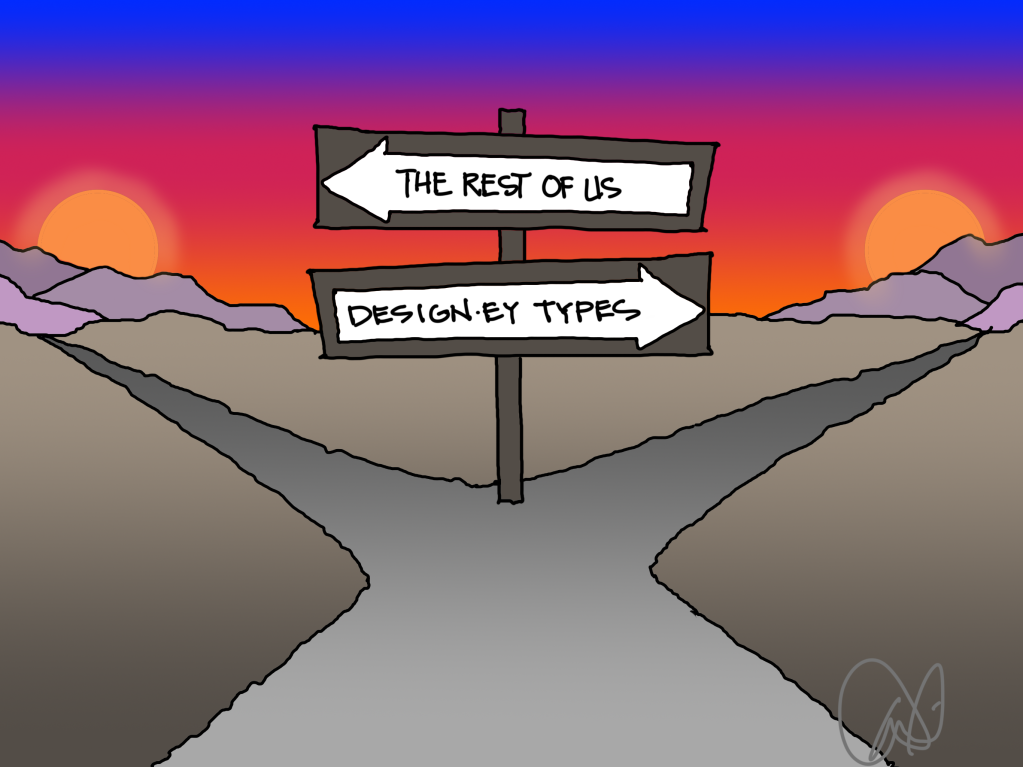
Introducing a second new series for 2025 focused on practical advice for designers.
Today I start a second new series for the year that I hope will make a strong compliment to the first. Last week I started the Simple Gift of Light series as a place to explore several key benefits of light in our lives: waking gently, moving with energy, relaxing easily, and resting deeply. This second series, Giving the Simple Gift of Light, is a space for me to build a toolkit of practical advice for delivering those same key benefits.
Or, in other words, the first series is about why light matters. This second series is about how to get the light you need. And let’s be honest – the how stuff can get technical and even boring for most.
So this series is not for Ashleigh, the imaginary homeowner and recipient of the Simple Gift series. Instead, I am writing this series for Luca, Avery, and Blake.
Luca is a self-employed interior designer working in the custom residential market. Luca knows something about design and residential construction but knows that their projects will look better and feel better if they can take full advantage of the transforming power of light. They have a good feel for decorative lighting’s role in establishing a room’s look but were only taught how to lay out recessed downlights in tidy grids and rows. Perhaps Luca has tried other sources of information, even taken classes, but there still seems to be a gap between possibility and reality. They are looking for practical, actionable solutions.
Avery is a lighting designer making a career move out of commercial design, where they spent most of their time running lighting calculations, researching fixtures, and presenting to the architecture firms that hired them. Avery knows a good deal about light itself from a previous degree in theatrical lighting design and a good deal about the technical nature of light from their career, but the residential world seems like the proverbial wild west. What are the rules, the best practices? How can Avery move into a new sector and not just approach the next kitchen like they would a million square feet of office space?
Blake is a homeowner, but the kind of homeowner that likes to figure things out and do as much of the work themselves as possible. Blake reads construction blogs, listens to design podcasts, and subscribes to Fine Homebuilding magazine. Why? Because Blake enjoys the technical side of residential construction and is planning to build a forever home. Perhaps Blake has already decided on a plan and some of the key construction details but lighting is yet untouched. Because Blake is a researcher, they know that most homes are built with terrible lighting and they want to avoid it. But the more they learn, the more confused they become. Is there a simple method to the madness that a DIY-er or so-called prosumer can follow?
Luca, Avery, and Blake are each very unique but unified by a key ingredient: each knows that light, when thoughtfully applied, can make a home more inviting, comfortable, and beautiful. Each knows something about construction and is unafraid of a little technical jargon and science, but none has the time or desire to apprentice themselves to a seasoned residential lighting designer for ten years to learn the ropes. They each need actionable advice. Now.
So if you fit the bill of the design-ey type, come on in. If the thought of beam angles scares you off, no worries. Try the Simple Gift of Light series and find Luca, Avery, or Blake to help you out. Or, better still, reach out to my team so I can justify this blog post as a business expense (hey, worth a try, right?).
I am writing this series despite already having answers to all these questions for two reasons. First, just because I can answer all the questions does not mean that better answers do not exist. I can keep learning and attempting to explain myself through blogging forces me to wrestle with questions more deeply than I permit myself during “regular” work hours. Second, residential lighting design is still too complicated, too unscripted, too messy to effectively scale to reach millions of homes a year.
To give the simple gift of light, we must wrap it up neatly. I will attempt to do just that, room by room, as I work through the series over the next year or so. How? By asking myself questions such as “how can I explain the fundamentals of residential lighting design in a single sketch?”
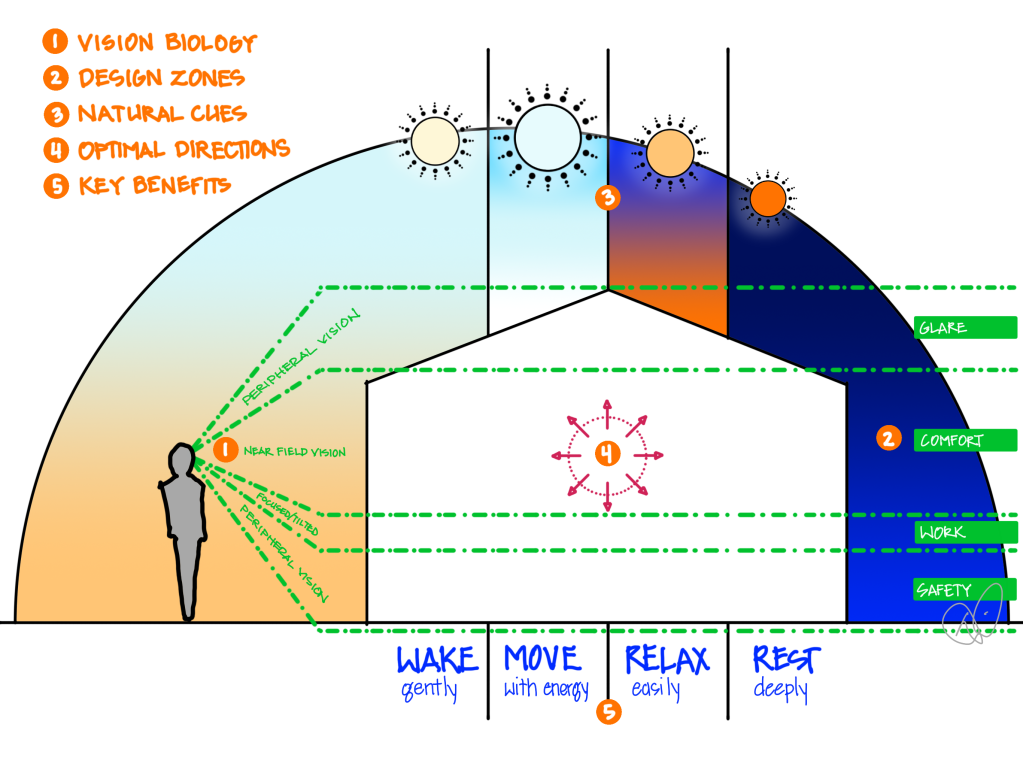
Residential lighting design comes in all flavors, from quick-and-cheap layouts of chandeliers, ceiling fans, and recessed lights to exquisitely detailed and highly expensive custom solutions. I shoot for somewhere in the middle, somewhere that will make a great starting point for Luca, Avery, and Blake. So when I say that this diagram is “everything you need to know” about residential lighting design, I am telling a half-truth. This diagram might be everything you need to know to make significant improvements over typical lighting, but it is most certainly not everything you need to know to deliver elite lighting design services.
But there is a lot here.
- Vision Biology. Light is meaningless until it enters our eyes, lands on our retinas, and is translated into electrical signals to our brain, so this is a great place to start our exploration of lighting. Our near field of vision is the sweet spot of sight, what we see in front of us when we hold our head level. Our peripheral vision – out of the corner of our eyes – is our most sensitive field of vision, capable of picking up minute changes in light.
- Design Zones. Those same vision fields can be translated into design zones that guide lighting decisions. The near field, for example, becomes the Comfort Zone where we see the faces of our friends and family, where we look at beautiful art, where we see our lovely cabinets, where we gaze out a window at the trees beyond. Our peripheral vision becomes our Glare Zone, an area susceptible to discomfort from bright sources.
- Natural Cues. The best light for our bodies and minds is natural light (and beneficial darkness) and lighting design should be influenced by what happens on a typical perfect day. The sun rises and sets, growing gradually brighter and cooler towards midday, then setting low, dim, and amber at the end of the day.
- Optimal Directions. One key component of good lighting design is simply to point light sources away from our eyes- we just do not find direct sources comfortable. That means light above our eyes should be pointing up, light below our eyes should be pointing down, and light at our eye level should be pointing away from us.
- Key Benefits. Why bother with all this work? Because great lighting can help us wake gently, move with energy, relax easily, and rest deeply. Yes, the house will look amazing and beautiful, too, but today I consider beauty a bonus byproduct of delivering the four key benefits.
Okay, that was easy…so now we need to apply this to every room of the house and dig into placing and picking lights. I am excited to get started!