
Giving the Simple Gift of Light #8
“THE CLAW CHOOSES WHO WILL GO AND WHO WILL STAY” – Alien #17, Toy Story
Sometimes choosing light fixtures can seem like an arcade game, and that is not a good thing. You take a good look at the products but cannot quiet the nagging suspicion that there is a better product deeper in the pile…if you could just uncover it.
Then, eyes on a product, you start the specification process. This one is going to be it, the one light fixture that solves all your problems. But the game is rigged – the first couple of tries are all but guaranteed to fail. Your first fixture choice didn’t turn out that well, so you have to try again.
If you stay at it long enough, if you pump in enough quarters, if you persist, you might just win the perfect spec. By then, of course, the fun is gone.
I routinely hear “I need more help with specifying fixtures” from our new hires and emerging designers. Light fixtures can make or break a design and there are literally thousands of products in millions of combinations.
Scared off yet? Let’s see if we can take this ridiculously complicated process and simplify it until it becomes useable.
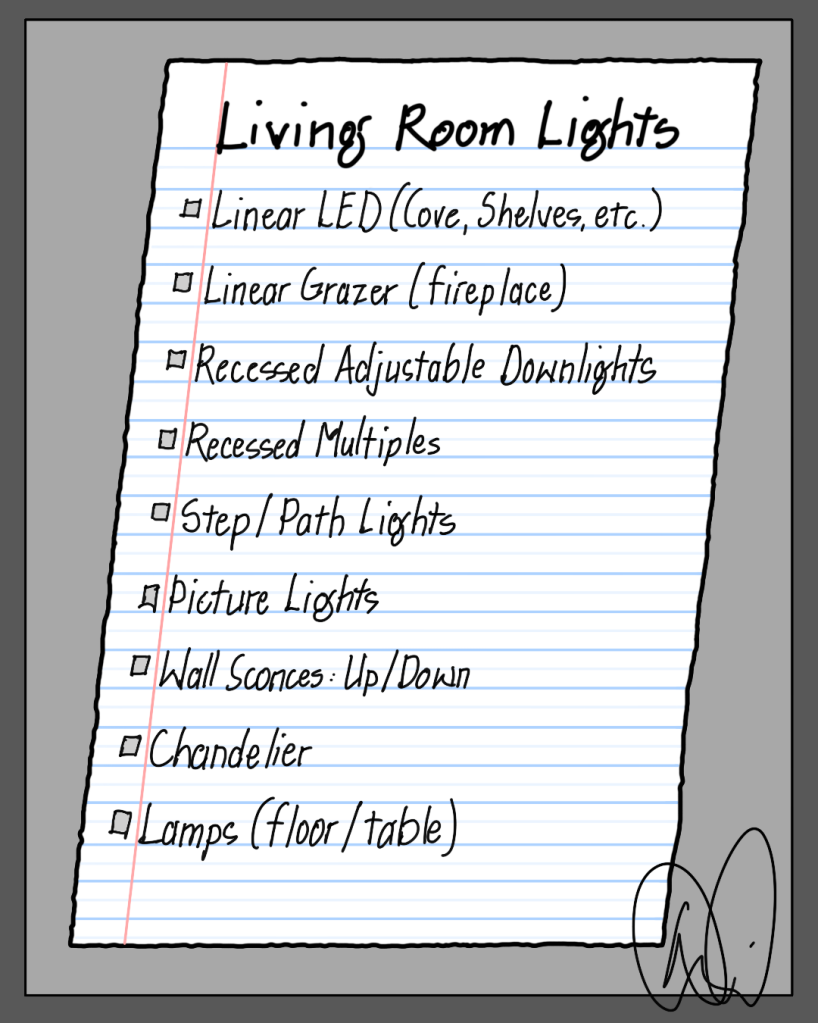
I often start the process by jotting down a quick list of fixtures needed. When I am designing someone’s home, I might do this room-by-room, after the entire plan is roughed in, or build it slowly as I move through the home. Once I have a list, I start the hunt for product.
Before we dig in, I have two disclaimers to make. First, after thirty years of lighting design, I have a head full of products and this process is usually pretty quick. In other words, don’t be intimidated if this is your first try: it will get easier in time. Secondly, I am keeping it rather generic in this series. Why? Because avoiding specific brands and product numbers allows this advice to last longer. Sure, I could give you an ordering code for a particular warm-dim high-output linear LED “tape,” channel, lens, and driver…but by the time you read this, there will likely be a better product on the market.
Okay, let’s dig in and see if we can make this a little less painful.
LINEAR LED
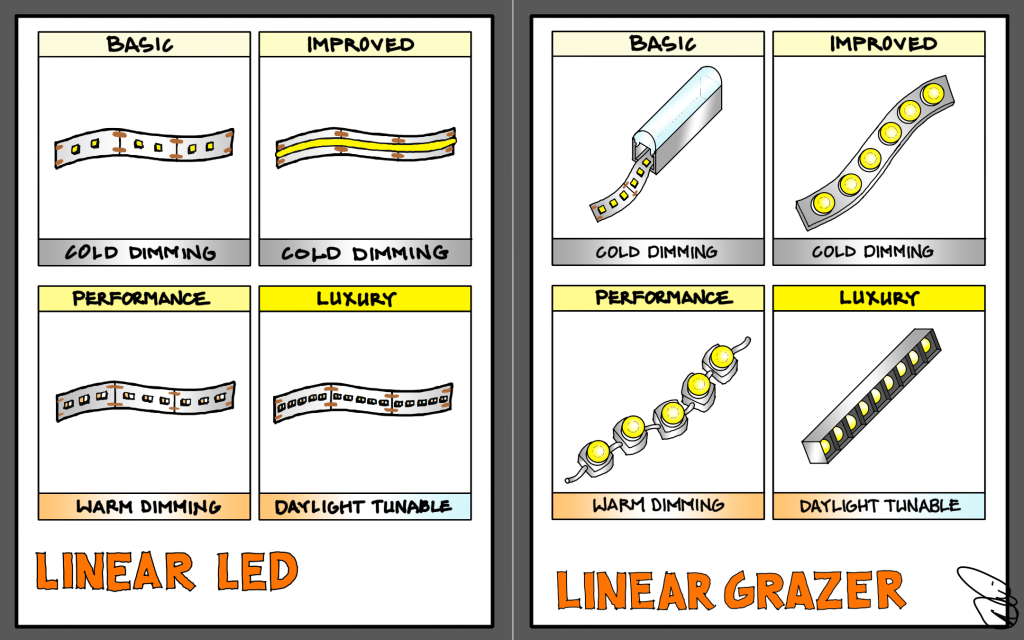
Linear LED strips, often called tape lighting, comes in a staggering variety of sizes, outputs, colors, and more. I use it almost everywhere, too. In our living room design, we placed linear LED lighting in shelving, coves, on clerestory windows, underneath the hearth, in toe kicks, and even under the sofa.
LINEAR LED: BASIC
Tape light is available just about anywhere and the internet is full of low-cost product. Dimmable LEDs, which I prefer to call “cold dimming,” fade in intensity and end up looking gray to our eyes, so I put them at the bottom of the list. Large pitch, or spacing between diodes, leads to spotting on lenses and nearby surfaces like walls and ceilings. Lower-cost products also discolor and fail faster, but in a pinch these can be a decent upgrade from nothing.
LINEAR LED: IMPROVED
COB, or chip-on-board, strips are increasingly popular and many offer short cut lengths that allow for increased precision. The continuous strip of phosphor covering the tightly-spaced, tiny LED chips all but eliminates dotting and leads to smooth lighting in even the tightest of applications. I categorize them as “Improved” when in fixed color temperature, but there are an increasing number of color-changing, tunable, and even warm-dimming COB strips available. I suspect most linear will be COB in the next couple of years.
LINEAR LED: PERFORMANCE
Tight chip spacing (pitch) reduces unwanted hotspots, but the addition of warm-dimming technology is a key upgrade in the performance category. There is a risk that the warmer (more amber) look of the dimmed strips will not appeal to everyone (or react well with all paint colors), but it can be far more comfortable and attractive than cold-dimming products. I see a lot of warm-dim from 3000°Kelvin to 1800°K; that works for me though it does not need to go much lower than 2200°K for me to be happy.
LINEAR LED: LUXURY
The future of lighting is “daylight tunable,” or technology that shifts from daylight-cool light (anywhere from 4000°K to 6000°K) down to sunset-warm light (between 1800°K and 2200°K). These fall into my luxury category because the strips cost a little more, but the bigger price factor is the requirement of intelligent control systems to manage the shift. You can buy smart strips like Hue and LIFX and Cync for DIY projects; pro-grade products typically required a skilled technician and programmer.
LINEAR GRAZER
Most linear strips have a wide beam dispersion in the neighborhood of 120°, meaning the light spreads out like a garden sprinkler, going everywhere. This is great in tight spaces like toe kicks, ceiling coves, and even under cabinets. For taller applications like our living room fireplace, however, specialized linear LED products gather up the light and “push” it in a narrower distribution, allowing the light to travel further. When placed close to a textured surface like stone, this effect is called “grazing” and there are a number of linear strategies to match.
LINEAR GRAZER: BASIC
Most standard linear LED “tapes” can be placed inside an aluminum channel and capped with a grazing lens. The lens focuses the light into a narrower beam of light, pushing the light further. This is a decent approach for short ceiling spaces or short grazing applications, but double-height fireplaces and features will be better off with a grazing-specific fixture.
LINEAR GRAZER: IMPROVED
There are some great linear grazing products that look like large tape light and even share the characteristic of flexibility with their lower-cost cousins. Instead of bare LED chips, however, linear grazing products have individual lenses over each chip, carefully collating and focusing the light. This tends to be more efficient than the basic solutions, thus producing a more dramatic effect. Color technologies are somewhat limited in this category.
LINEAR GRAZER: PERFORMANCE
I am delighted by the innovation in the grazer category, especially by the increased flexibility of some performance products. These are kind of like high-performance holiday string lights, a series of individual LED lights connected by flexible cord. This allows the grazer to be bent in multiple directions, turn corners, and wrap around columns with ease. Bonus points for adding a color technology like warm-dimming, if you can find it.
LINEAR GRAZER: LUXURY
Two key differences push grazing into the top category: color technology and glare control. Bumping up to tunable color changing, from cool white to warm white, is a key element of the best lighting solutions for a variety of reasons from aesthetics to circadian rhythm. Glare control, usually in the form of louvers, shields individual “cells” from view, making for a much more comfortable environment.
RA DOWNLIGHTS: BASIC
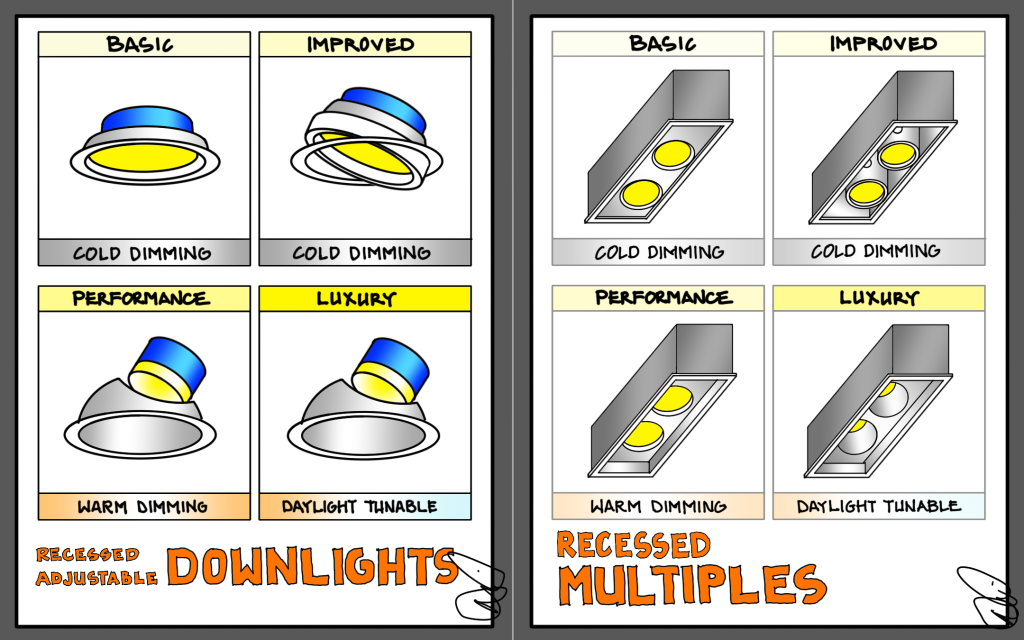
Recessed Adjustable Downlights can be very useful tools throughout the house, but a surprising number of homes now feature glare-inducing wafer (or disk, pancake, panel) lights that do a terrible job pushing light to the countertops. Avoid these if you can- they do not even qualify as recessed, adjustable, or downlight.
RA DOWNLIGHTS: IMPROVED
Lights that pivot are often categorized as gimbal-style and can offer a good step up in functionality. Try to avoid those that are just wafer lights that pivot – you want a fixture with a reflector or multi-faceted lens to push light. If the face of the light source just looks like a frosted disk, keep looking.
RA DOWNLIGHTS: PERFORMANCE
A true performance recessed adjustable downlight will allow for aiming (tilting) of the light source up inside the ceiling where the mechanisms are hidden. This allows the light source to be further above the ceiling and the general rule is that the higher the recess, the lower the glare. I personally like those with frosted silver reflectors, but mirror-like silver reflectors will reduce glare even further. Black reflectors are better still but can draw attention in light ceilings when turned off. Expect to pay several hundred dollars for a good downlight in this category.
RA DOWNLIGHTS: LUXURY
Tunable recessed adjustable downlights usually cost more (and cost more to control), so I’m categorizing them as luxury. If we can get the market to shift, these could be made more affordably and that would make me very, very happy. Daylight Tunable fixtures that range from a warm 1800°Kelvin (K) to a crisp cool 4000°K are my current favorite fixture. Luxurious fixtures can also be smaller and have premium construction and finishes. I think a 2-3” diameter fixture with 1000 lumens and a 40° beam will satisfy most situations.
RECESSED MULTIPLES
I turn to recessed multiple downlights, or “multiples,” in a number of applications from lighting a hallway to providing pillow lights and art lights in bedrooms. In the Living Room, I find multiples handy for reducing ceiling clutter while allowing me to pack in more light sources to compensate for tall ceilings. Like all lighting products, you can spend $100 or $1000 on each fixture.
RECESSED MULTIPLES: BASIC
Basic multiples allow for adjustability, often using gimbal-style rotation mechanisms, and are available in fixed color temperatures for “cold dimming.” These may have higher glare than some of their cousins.
RECESSED MULTIPLES: IMPROVED
Some models have small track-style “heads” inside a box that allow for greater flexibility. Some can even be pulled down below the ceiling plane, allowing for extreme aiming, though at the cost of a tidy ceiling. With multiples, aiming flexibility is key, so this makes a worthwhile trade in most cases.
RECESSED MULTIPLES: PERFORMANCE
Performance multiples should have good adjustability but also color technology upgrades like warm-dimming that softly warms like a setting sun when dimmed.
RECESSED MULTIPLES: LUXURY
Tunable once again makes the top tier of multiples perform better than any of their relatives. Keep an eye out for clever, glare-reducing, in-the-ceiling aiming mechanisms. The same rule for downlights is true here: the deeper the source, the lower the glare.
PATH/STEP LIGHTS: BASIC
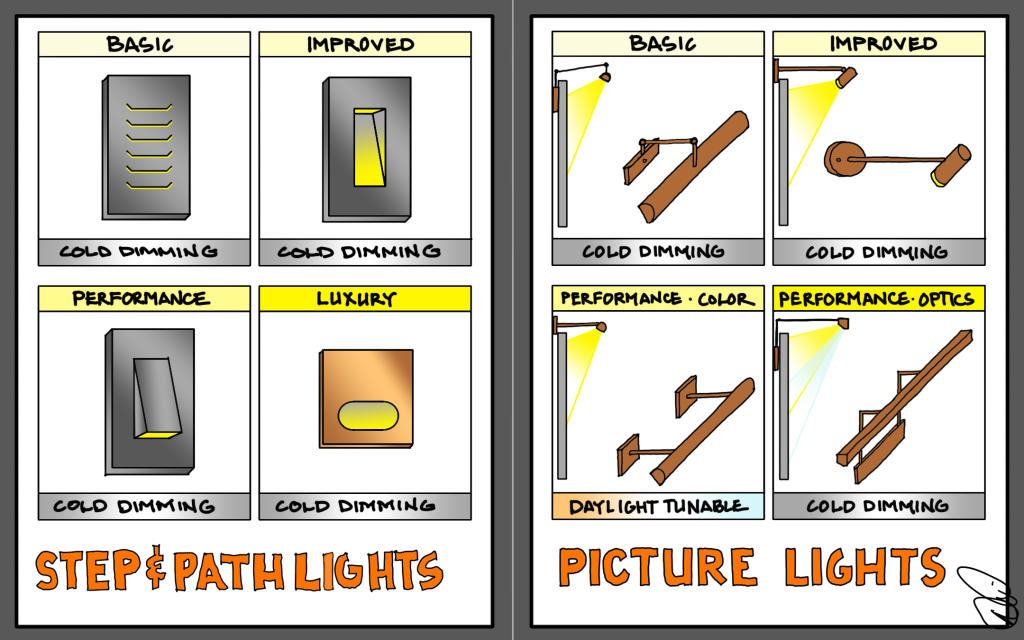
Theater-style path lights, also called step lights, were developed to allow patrons to safely navigate ramps and steps in darkened theaters. In homes, the same style of fixture provides reassuring pools of light along key pathways through the home. Low-cost interior path lights often have slanted louvers to direct light downwards while shielding your eyes from glare. Almost all path/step lights will emit fixed white light, so consider 2700°K warm white or even warmer if available.
PATH/STEP LIGHTS: IMPROVED
There are some lovely step lights for under $100USD that feature a modern design with recessed light sources and “scoops” that allow the light out and down to the floor. This is the style I use the most because it also eliminates any significant protrusions from the wall and looks attractive all day long. There is a bit of a high brightness to the scoop, a trade-off that should be considered.
PATH/STEP LIGHTS: PERFORMANCE
Interior path lights that completely hide the light source (and without any reflecting surfaces) will be the most comfortable at night, though they must stick out of the wall to accomplish the task well. I wish there were more products in this category that I liked, but a good number of them are so shallow and shielded that you mostly end up with light on the baseboards and not across steps and floors. Look for units that push the light source out an inch or so and spread light out widely.
PATH/STEP LIGHTS: LUXURY
There are several ways to hit the top of the line in interior path lights: get tiny, choose premium finishes, or make them disappear. Tiny lights, as small as a nickel, all but disappear but are also towards the top end of costs. Premium finishes are available in some higher-grade path lights and a nice brass or polished steel will feel luxurious. And my favorite luxury move? There are path lights that can be mudded into the wall and painted to match, leaving only a small groove visible that emits light.
PICTURE LIGHTS
Picture lights or art lights exist at the crossroads of architectural performance lighting and decorative lighting. They have to look attractive even when not in use, which often pushes aside performance considerations. This may be fine when the art is not important, but higher-performing fixtures can light the art better and add more comfortable illumination to the room.
PICTURE LIGHTS: BASIC
Dimmable LED picture lights come in a variety of styles ranging from classic ornate brass to modern streamlined matte black, but most will put light on art from a linear source of light. The downside to most is that light will be concentrated near the top of the art, leaving the bottom underlit.
PICTURE LIGHTS: IMPROVED
Arm-mounted spotlights can deliver more “punch” to artwork and often have beam-changing options that account for different sizes of art. These are decidedly modern in appearance, and costs can increase when two or more or needed for larger features.
PICTURE LIGHTS: PERFORMANCE/COLOR
I deviated from the previous categories a bit here because art lights are highly specialized and it can be very difficult to find all the features in one package. Color technology is one key consideration, as the color of light will directly and significantly impact the appearance of the art. Daylight tunable products allow us to select just the right color temperature, whether warm or cool, so we get to enjoy the art the most.
PICTURE LIGHTS: PERFORMANCE/OPTICS
There are a few products like Revelite that go a step beyond the competition by allowing multiple optical systems within a single system for precision lighting. These products allow you to aim a portion of the fixture at the top of the artwork and a separate section at the bottom, allowing individual dimming and optics for each component to get the light to be just right. If you have a large Seurat, this is the way to go.
WALL UP/DOWN SCONCES
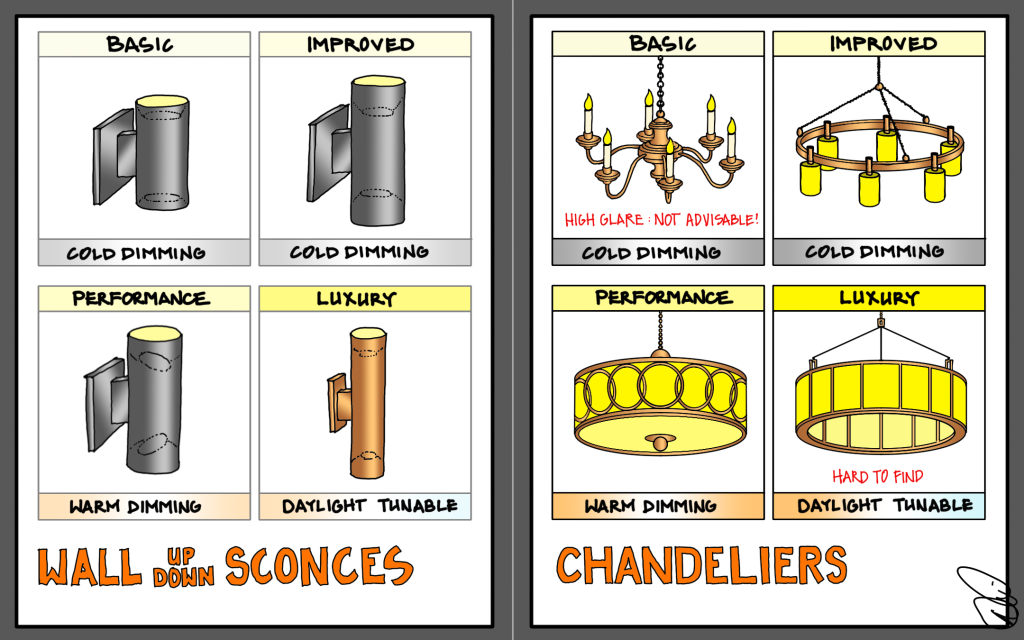
We use a surprising quantity of these humble wall sconces on our projects for two reasons: the provide easy-to-install uplighting and downlighting and they can disappear into the architecture. They show up indoors and out on our projects and work just about anywhere you need a little extra light but the ceiling is too far away. When mounted at eye height, they can also be low-glare, an added but important bonus.
WALL UP/DOWN SCONCES: BASIC
Whether square, round, or some fancy shape, the basic up/down sconce does just what it promises: sends light upwards and downwards. Cold dimming LEDs are often more affordable but may you feeling, well, cold late at night.
WALL UP/DOWN SCONCES: IMPROVED
Glare is always a key consideration in lighting and some subtle differences in construction can improve the quality of the simple up/down sconce. Just like a recessed downlight, a small recess inside the fixture pushes the bright, glare-inducing source of light further inside the fixture, reducing glare and increasing comfort. Look for this recess and you likely have a better fixture.
WALL UP/DOWN SCONCES: PERFORMANCE
Add in warm-dimming technology for softly illuminated evenings for a performance upgrade. Higher-quality fixtures may also offer adjustability so you can push lighting more into the room. While glare can become an issue with this approach, the added flexibility can increase the positive impact of these performance sconces.
WALL UP/DOWN SCONCES: LUXURY
Tunable white light sources once again makes the upgrade to luxury products worth considering, though the technology is becoming increasingly available and affordable. Other luxury upgrades are going to fall primarily into the aesthetic category, like smaller diameter cylinders, decorative wall plates, and custom finishes.
CHANDELIERS
Well…I might get into trouble with this fixture. Chandeliers were, hundreds of years ago, the most high-tech method of illuminating large spaces. Candles and oil lamps burned in only one direction, upwards, so it became necessary to get these high off the ground where their light could spread out everywhere.
Today, we can do much, much better, but we still have nostalgic connections to chandeliers, and they are often included as “statement pieces” in living rooms. What statement they make can be questionable but could include: “these people spent a lot of money on something big and fancy,” or “these people value appearance over function and happily spent thousands on outdated lighting while skimping on modern performance fixtures that Louis XIV would have demanded if they existed hundreds of years ago.”
Am I in trouble yet? I love a good chandelier, but never at the expense of good lighting.
CHANDELIERS: BASIC
If a chandelier has bare bulbs or tiny narrow LED strips, it will introduce substantial glare into the room unless dimmed very low. These become strictly decorative and provide little to no usable light in a space without accompanying glare. Avoid them when you can, especially if budget is critical. Think of these like the jewelry of the home – expensive, pretty, and with no practical function.
CHANDELIERS: IMPROVED
I have had a series of inexpensive chandeliers above my dining tables that point light downwards, with frosted glass shades that soften the light and reduce glare. The key upgrades here are pushing light down where it can be used and shielding/hiding the bulbs.
CHANDELIERS: PERFORMANCE
Performance chandeliers are few and far between; there just isn’t much demand for something that looks great and delivers usable, low-glare light into a room. Sadly. If you are looking to upgrade, however, there are a few options. First, look for warm-dimming technology or purchase warm-dimming LED bulbs to soften and warm up the light. Secondly, look for fixtures that hide the light sources and spread the light over large diffusers or shades. This softens the distribution of light, all but eliminating glare.
CHANDELIERS: LUXURY
I marked these “hard to find,” which may seem odd given the relative ease of locating very beautiful and very expensive chandeliers. It is hard to find great-looking chandeliers that also deliver usable, low-glare light, however, and even more difficult to find said chandeliers in tunable white technology. You may have more luck searching in the commercial lighting category.
LAMPS
After bashing chandeliers, it is a relief to finish with lamps. I love lamps, as a general rule, and there is no better way to introduce usable, comfortable light to a space. In no space is this truer than living rooms.
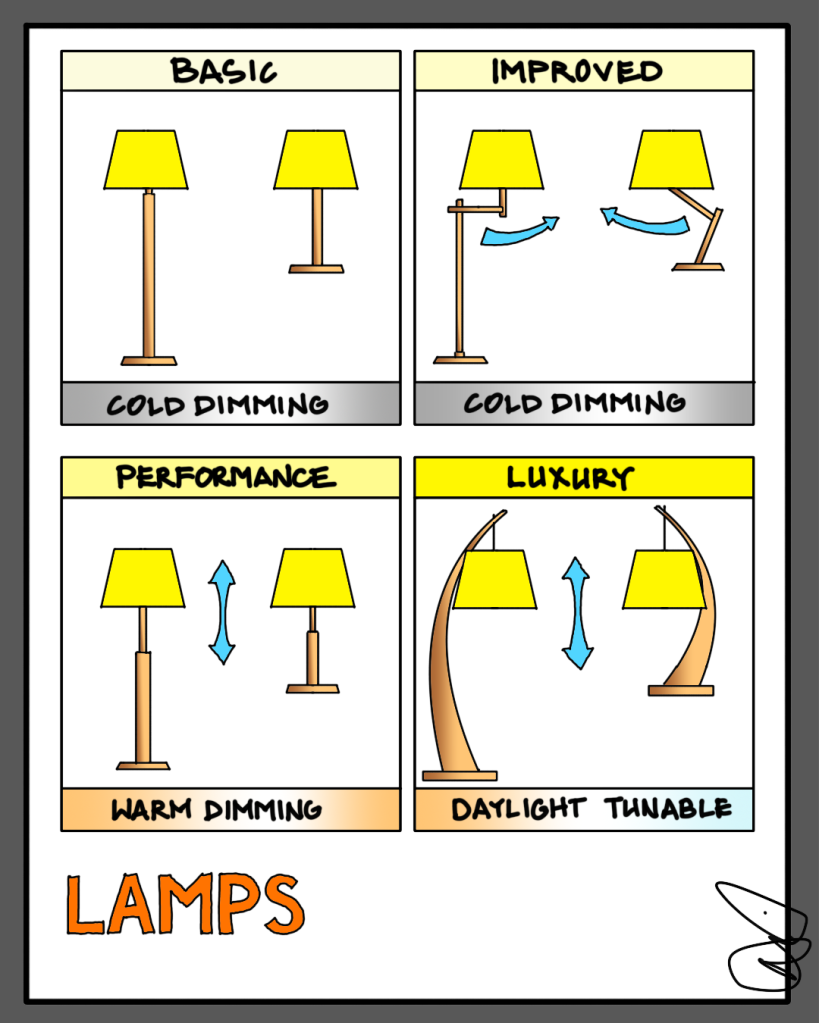
Lamps come in endless styles, but there are some key considerations you can read more about in the Pick the Places 2 post. In short, a soft fabric or glass shade that hides the bulb or light source is critical and choosing the right height can also dramatically impact comfort.
LAMPS: BASIC
Can I say much about these? It’s a lamp. Dimmable is good, but cold-dimming is far from my favorite technology.
LAMPS: IMPROVED
I give a higher rating to light fixtures that can swing closer to couches and chairs for their ability to deliver light to books, knitting, games, and anything else we want to see.
LAMPS: PERFORMANCE
Height adjustment is important to reduce glare: too low and the light does not reach your book, too high and you can see the bare bulb. Add in warm-dimming light bulbs and you have a lamp with the potential to deliver better light every night.
LAMPS: LUXURY
I have tunable white light bulbs in my bedroom and have had them in my living room in the past. While these require some kind of intelligent lighting control, adding to the cost, they allow me to set an appropriate mood for the time of day and avoid light that is too “yellow” or too “blue.” Add in adjustability and a little style and you have a luxury product worthy of inclusion in the most beautiful spaces.
Whew, these posts are killer. Am I seriously considering writing one of these for every room of the house? Sure, I can copy and paste a bit as fixtures repeat, but this is still a bit of a slog to write so I can only imagine what you just went through to read it.
Plowing onwards….