Think Light Series
A few weeks ago, I had the privilege to attend a presentation by Prem Kumar at the IES Maritime Annual Conference on Prince Edward Island. As is the case with good presentations on lighting, Prem got me thinking.
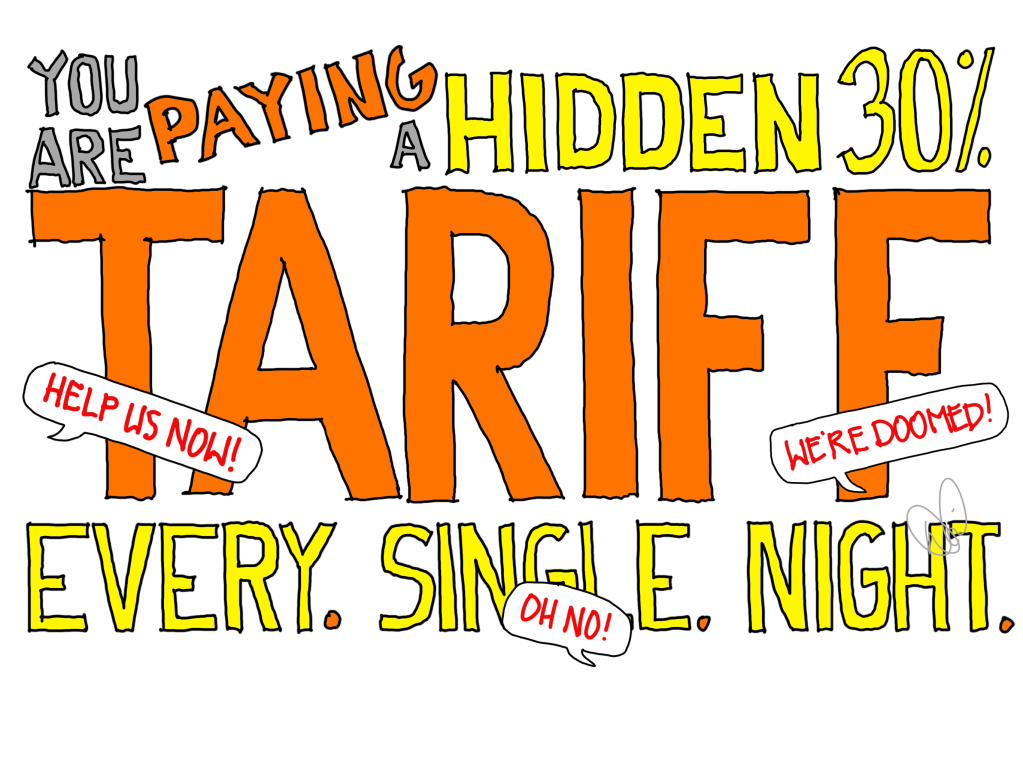
If you have lighting on the outside of your home (or business), you are most likely paying a hidden 30% energy tariff as a result – every single night. It can be quite easy to avoid this tariff, if you know how.
I admit that I use the term tariff because, in our current economic climate, there are few words that elicit the same level of negative reaction. Tariffs – to accomplish their primary political and trade objectives – are designed to raise prices artificially, and that makes anyone who sells anything anxious. Will customers pay the higher prices, or will I see my sales drop?
Tariffs also make buyers unhappy, because anything tariffed inevitably costs more to purchase. So are you paying a hidden 30% tariff on your outdoor lighting energy, every night? Technically, no. But, largely because of decisions made by others and our willingness to follow along, we are paying a 30% upcharge for electricity that is completely wasted outdoors. There is a better way.
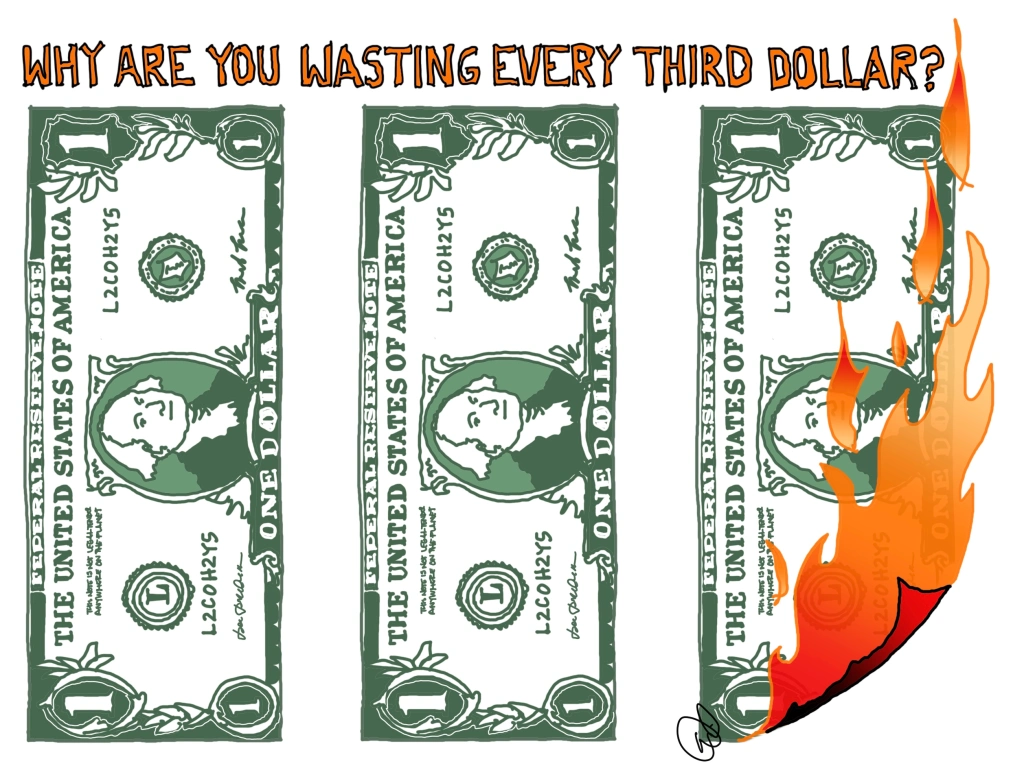
Imagine you have $100 to spend on electricity for your outdoor lighting and you pay it to your light fixtures, who in turn pay it to the electric utility. Can you imagine handing your light fixture $100, watching them send $70 to the utility, and then watch them hold a match to the remaining $30?
As you watch your hard-earned money literally burn up, you would get angry. “What is the value of burning up my money for no reason?!” you might ask. And you would be smart to ask, to protest, and to look for a better way to do it.
So go ahead, ask why you are wasting 30%, protest, and look for a better way to light your outdoors.
In his presentation on dark sky practices, Prem Kumar shared a few startling facts that should encourage us all to rethink our outdoor lighting, and the 30% waste was the one that stuck out to me the most. But others resonated as well: from 2011-2022, the world saw an average of 9.6% increase in outdoor lighting every single year. That means the global outdoor lighting quantity is doubling every eight years.
The results of this incredibly rapid brightening of our nights? 80% of us now live under sky glow, a form of light pollution that can disrupt our sleep cycles, conceal the stars that were our birthright, and that wastes our dollars and resources as it disturbs our wild neighbors.
Some sectors of the lighting industry are well aware of this trend and doing what they can to push against it. One tool is the B.U.G. Rating, a system that measures the amount of light pushed upwards, backwards, and in glare zones. Created by the Dark Sky Association and the Illuminating Engineering Society, the BUG rating system can be useful in discussing fixtures.
In the simplistic diagram above, 1 and 2 show typical streetlighting situations. 1 projects useful light to the pavement and sidewalk, as shown in the green triangle. Light in the yellow zone that heads towards our pedestrian is likely to cause glare, which can make it more difficult to see at night. Light in the yellow zone behind the fixture is Backlight, most of the time wasted on yards and even hitting houses and buildings. The red swath above indicates Uplight, completely wasted and irresponsible.
2 shows a streetlight that is “dark sky friendly” and “full cutoff,” meaning there is zero uplight. It also limits glare potential and backlight, leading to a better B.U.G. rating.
3 and 4 show the same concepts applied to our front porch light. Backlight might not be as big a deal here, but glare and uplight are often even worse from the lights we mount to our homes.
Scott Lind, a dark sky advocate here in Wisconsin that continues to teach and inspire me, does more than stand up and present. A licensed electrician and electrical engineer, Scott also works with communities to upgrade their lighting to limit glare and uplight.
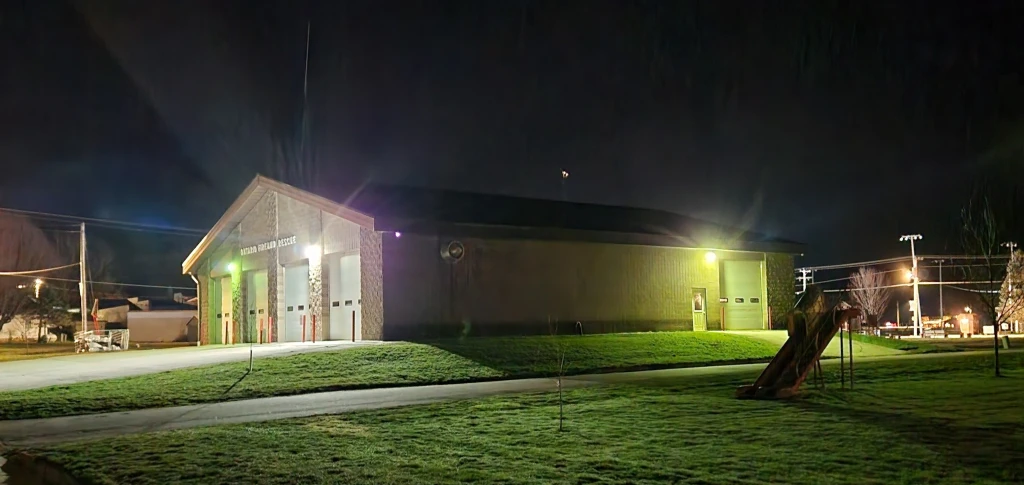
Take a look at the emergency response building above and you may recognize the “wallpack” style fixtures I like to call glare bombs. You can see a few important things, to be sure, but you can also see that the BUG rating would be pretty lousy. Even the camera’s sensors are overloaded by glare and you can clearly see light headed into the night sky.
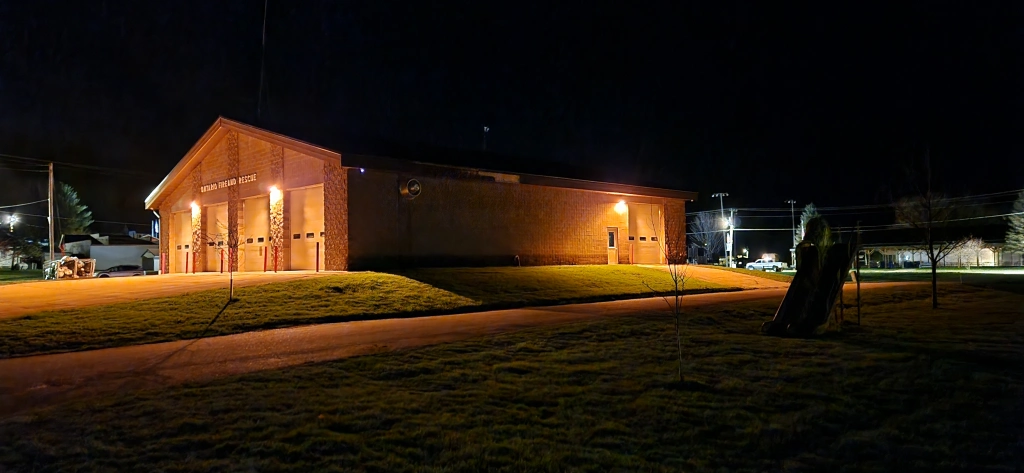
Scott replaced the lights with 1800°K full cutoff fixtures and delivered the following results:
- Energy usage was reduced by 75%. Yes, he basically cut out a 75% “tariff” on their energy bill, every single night.
- Sky glow, a key measurement of light pollution exacerbated by uplight, was reduced 92%.
- Uniformity, a holy grail metric for safety such as on sidewalks, was improved by 35%.
- And did it get darker? Yes, but only in your glare zone and in the night sky. Average light levels were identical, as was minimum light level. In other words, we got the same light we needed but stopped paying for all the stuff we did not need.
Sound expensive? Energy savings paid for the fixtures themselves in only two years. Imagine relighting a town for a decade and the positive impact we could have just by getting smarter about our light.
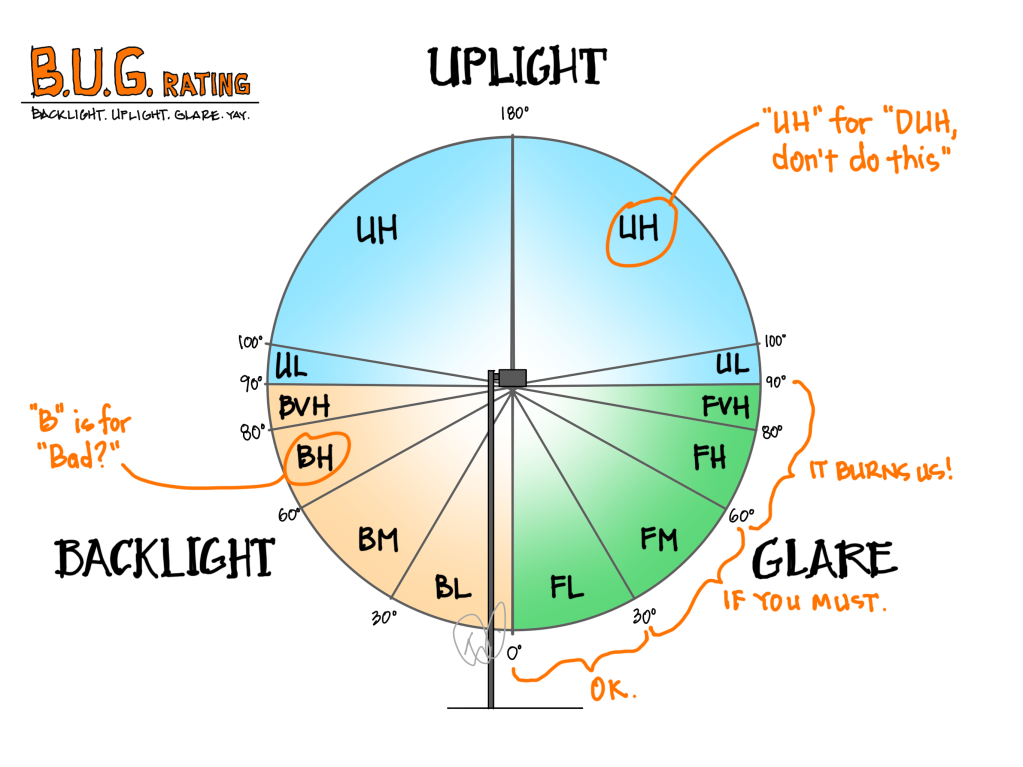
BUG ratings look something like this for a fixture: B1 U3 G2. The numbers 1-5 essentially describe how good it is (0) or how bad it is (5) in each of the Backlight, Uplight, and Glare categories.
These numbers are determined mathematically (search BUG ratings for charts) based on the amount of lumens “pushed” into each zone. For example, UH is the “Uplight High” zone and the worst offender of sky glow. A U0 rating, the best rating, requires absolutely zero lumens emitted into this zone.
The useful light from this pole-mounted area light is primarily found in the FL and FM (frontlight low and medium) zones; any higher and it becomes glare.
Many professional-grade outdoor area and streetlighting fixtures may be listed with a BUG rating, and some codes could require specific scores as minimums to increase the likelihood of good light and less waste. BUG ratings are just one tool to help determine outdoor lighting, but the principle of reducing backlight, uplight and glare are key concepts whether you use the BUG rating or not.
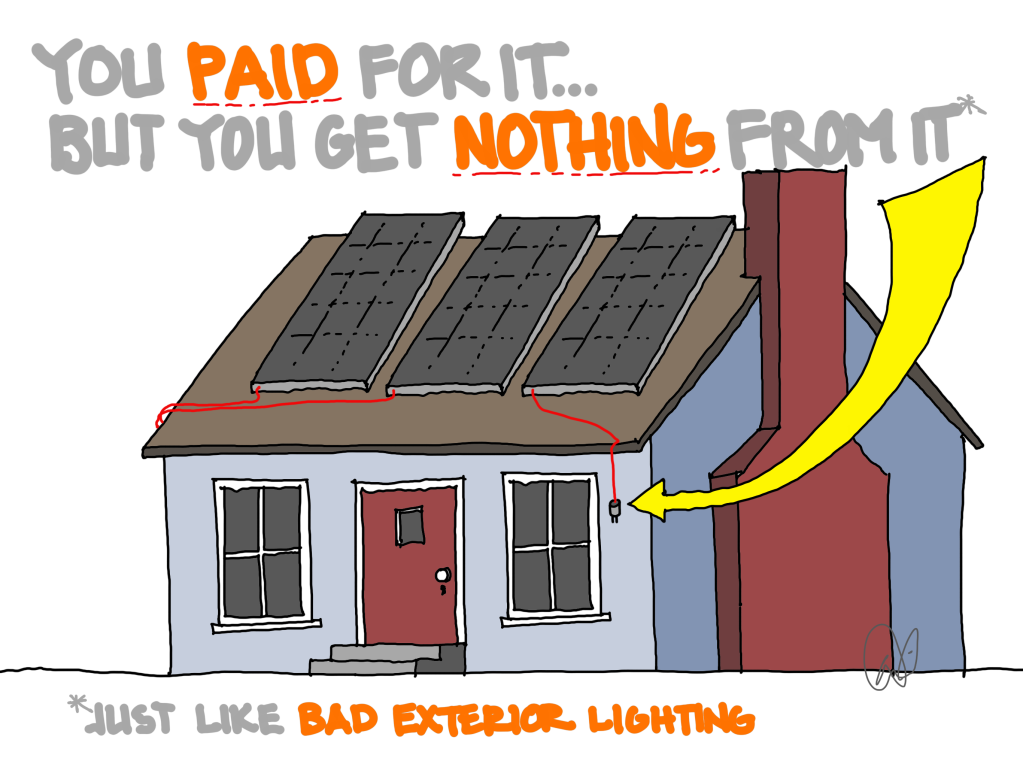
As you may have noticed, I had a little fun coming up with ways to make the impact of 30% waste apparent, and I have one more to wrap this up.
Imagine you buy three really nice, high-performance solar arrays for your roof. You plan to use this electricity to charge your electric vehicle, to run your induction stovetop, to power your house during outages, and to sell back to the utility to make your electricity costs go away.
You hire installers who place the panels on your roof in full sunlight and then proceed to connect two of the panels to your home’s electrical system.
The third panel? They leave it unplugged. You paid for the solar panel. It is generating electricity every day.
Both your money and your electricity are wasted, every single day.
If you have outdoor lighting pointed up, decorative coach house lanterns with glass shades, or security lights that point outwards, you are wasting money and electricity, every single day.
We can do better, and there are countless reasons to stop paying our 30% tariff on outdoor lighting.
Read more of the THINK LIGHT series HERE.