
Giving the Simple Gift of Light #7
Here’s a tough truth of lighting design: most rooms will be better served with more lights than you might think. If you are sitting in your living room, look around. Count how many light fixtures (or ceiling fan lights) you have in your room. If it is less than four, I would doubtless recommend more, unless it is an exceptionally tiny living room.
My own living room is roughly 14’ square, not gigantic, and I count 8 current light sources. There are three floor lamps, two table lamps, an indirect ceiling light, a string of lights in a birch tree branch, and strings of lights cascading in the sheer curtains on the bay windows. Oh, wait, there is a ninth source – the ceiling fan light. I forget about it because I am happier when it is turned off.
More lights might make for a more comfortable space, but the “more approach” also creates problems. It takes more money, more electrical work, more electricity, more light bulbs to replace, more lights to turn on and off.
My job as a lighting designer could be described as informed problem-solving, a careful balancing of what is best and what is affordable, or what would be awesome and what would be practical. So when you read the suggestions below for places to put lights in the Work Zone and Safety Zone, please know that rarely will we recommend all of these solutions at once.
Oh, and stick around for the tips for getting the most out of lamps at the end of this post. If you are not building or remodeling, that should be information you can use right away.
WORK ZONE WINNERS
In the first Living Room post we placed lights in the Comfort and Glare Zones. Now it’s time to get to work. And what “work” do we tackle our living rooms? I am currently sitting on the couch in the living room and writing this article, my adult son is on his phone, and my partner is reading a book. Earlier today I played a board game with my daughter and we started watching a movie that turned out to be a dud. Can you tell we are in a vacation rental? We don’t normally range that many activities in a single afternoon.
All of the activities mentioned except watching the movie involve seeing something in our hands – books, computers, phones, games – and that means we need good light where we sit.
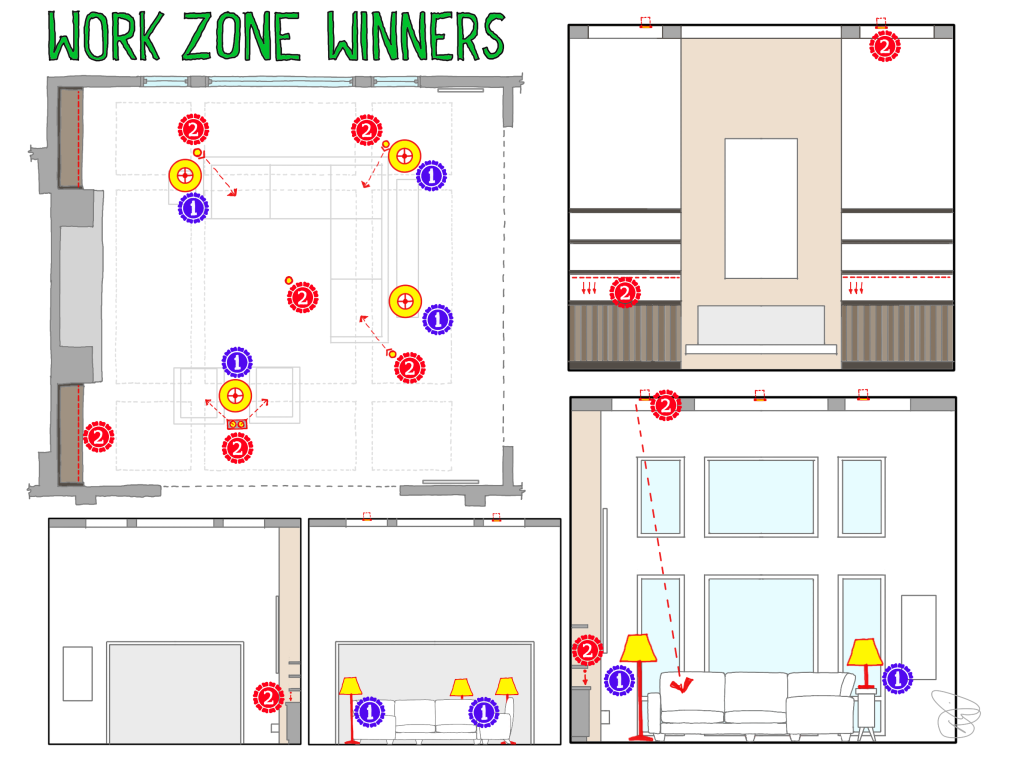
WORK ZONE: FIRST PLACE
Lamps, whether floor lamps or table lamps, are typically the easiest method to deliver good light in the work zone right where we need it. Some of our clients do not like lamps and want to minimize the quantity to create an uncluttered look. I have nothing against uncluttered minimalism, but where do you draw the line? You wouldn’t get rid of all the seating just to minimize clutter, because comfortable seating is a baseline need. Good lighting should be considered a baseline need as well; without it, you will miss out on comfort and beauty every single night.
In other words, get some lamps already.
In the diagram above, I imagine the prime reading/game playing/knitting areas are the chairs, ends of the sectional sofa, and inside corner of the sofa. Optimal lighting is just over the shoulder of the seated person, which keeps the light close at hand but just out of glare-causing visibility. At the end of this post I will get into lamp heights, which also make a difference into how well a particular lamp works.
WORK ZONE: SECOND PLACE
I awarded second place to a three-way tie: coffee table downlight, countertop linear, and recessed adjustable downlights for reading. As mentioned above, rarely would I recommend all three of these layers, as each has a unique use case.
A coffee-table downlight is just that: a recessed downlight located directly over the coffee table (I would use adjustable downlights as coffee tables have a tendency to migrate). Most of the time, we do not “work” on the coffee table; it is simply there to hold books, drinks, remotes, and perhaps a few feet. That makes a dedicated light for the Work Zone rather superfluous, unless you play board games, do homework, or use the table for any task that requires reading or manipulating small items like game pieces. If you like playing board games in the living room, then this light is for you.
Some living rooms have cabinets and shelves, often on either side of a centrally located fireplace, and these can be simply there to hold and display objects (see Comfort Zone suggestions in the first post). Occasionally, we see wet bars or other functional uses to the counter-height shelf, and adding linear lighting to illuminate the shelf can be helpful. Just be sure to make it separately controlled (switched) so that it can be turned off or down when you are seated.
Recessed adjustable downlights for reading areas are in second place because lamps do a much better job with far lower risk of glare. When I lose the argument for lamps, however, I need a go-to solution that works. The same principle applies: placing light sources just off and behind the shoulder means the potential glare is pushed out of eyesight, making the light more comfortable. As with any direct source, however, shadows can be sharp and distracting.
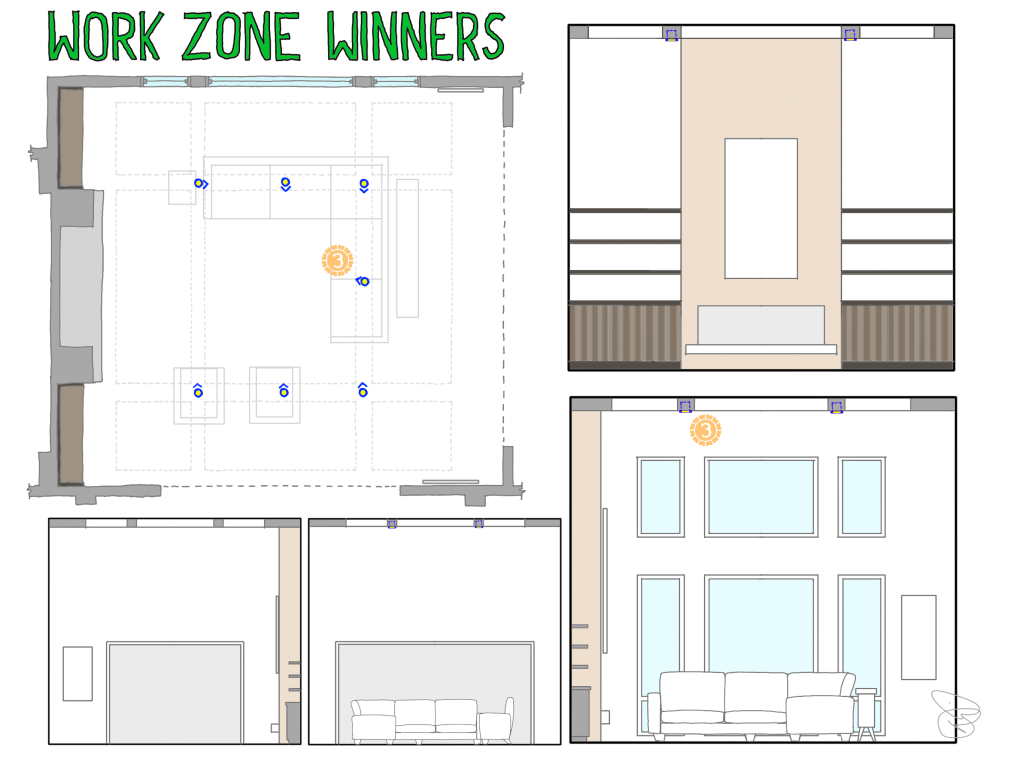
WORK ZONE: THIRD PLACE
Recessed downlights are great at pushing light to the Work Zone from high above, but straight downlights are also great at introducing bright spots in our Glare Zone. In other words, we can easily read the book we are holding but our comfort will be diminished. Pushing recessed adjustable downlights over the shoulders of readers helps, but is really only practical when you know, long before construction is complete, exactly where the furniture will land.
That perfect situation happens rarely, and even then, only at the highest level of luxury homes. So here, in third place, is a more common solution: recessed downlights, clustered near the seating, recessed into beams.
This works moderately well by creating a strong field of light in the Work Zone but will come with the increased risk of glare mentioned above. I sketched this idea out and then thought “is there a better way?” If lighting design is problem-solving, then this solution might create as many problems as it solves.
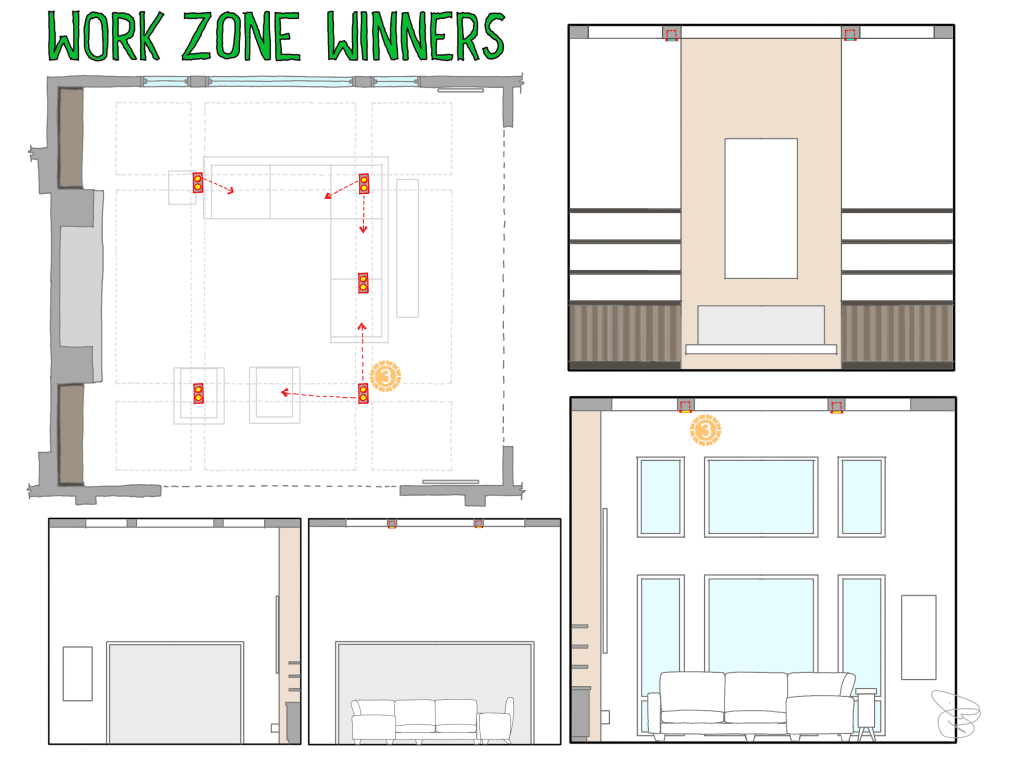
So I tried again. The goal: a lighting solution that delivers strong light to the Work Zone, whether or not the occupants choose to add lamps, that minimizes the potential of glare, and looks clean on the ceiling (meaning organized and aligned).
Enter the recessed multiple downlight.
Recessed multiple downlights are a unique solution that combines several adjustable downlight modules in one housing. Individual “heads” can be pointed in different directions, meaning a single recessed multiple in the middle of a hallway can potentially light art on opposite walls at the same time.
In the illustration above, I get ten spotlights with only five locations, which cleans up the ceiling nicely while still allowing flexibility and wide coverage. Higher ceilings are even better use cases for recessed multiples, as precise placement can be stretched when the light has further to travel.
It just so happened that I could place recessed multiples at the ceiling beam intersections and light over the shoulders of most of the seats. I added a unit to fill in above the couch and another above the chair at lower left but note how the placement of these units is directly in the Glare Zone. This is why the recessed multiple solution is in third place – lamps are still the best solution.
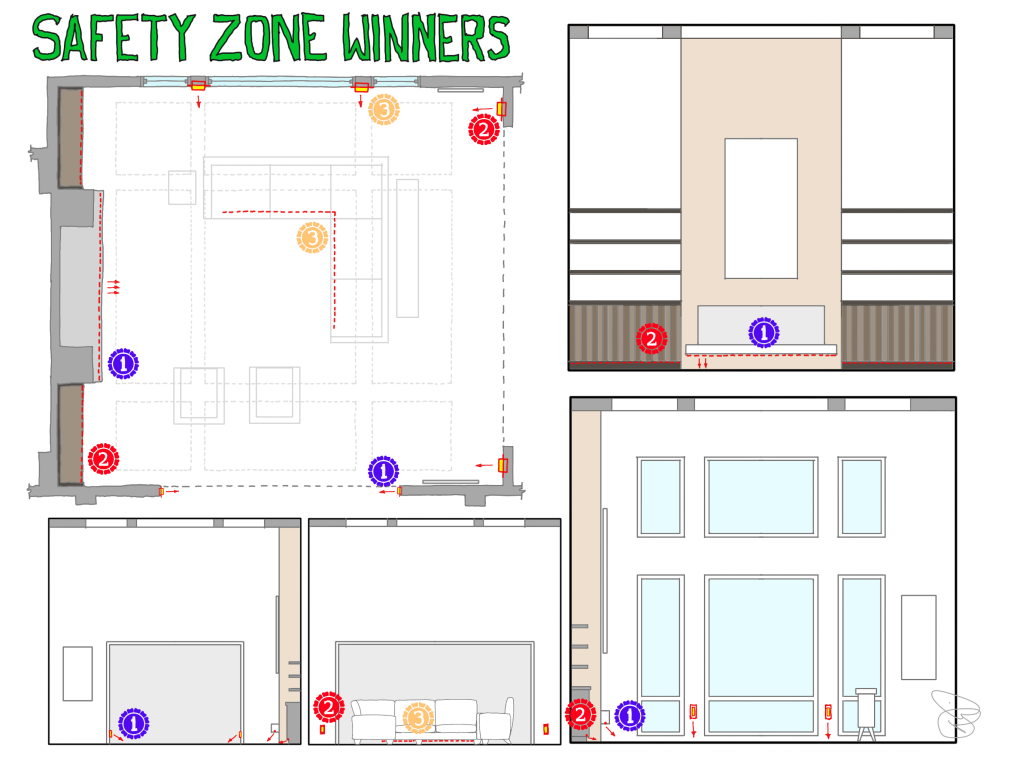
SAFETY ZONE: FIRST PLACE
My wife and I end many days sitting on the couch in our living room reading or watching a favorite show, and neither activity requires the room to be brightly lit everywhere. Two lamps will cover our two books, and even those are not needed if we are watching the television. Complete darkness, however, is not particularly comforting or safe, so adding a few touches to the Safety Zone can help us enjoy each evening more.
I have two recommendations for first place: recessed path lights in doorways and light underneath floating hearths.
Our team specifies dozens of recessed step lights (we call them RSL’s) in our typical projects. These lights, more often seen in theaters and on outdoor patio steps, are located below our waistline and point light down onto the floor or ground for safe and comfortable nighttime navigation. We should call them recessed path lights, as we use them in plenty of areas without staircases. In the living room above, I have two different applications, the first-place selection being on the inner facing of the cased door openings (door frames). This directs the light into the transition area between the living room and adjacent hall, doing double-duty and increasing comfort and safety. Just last week I heard one more client talk about how these lights were among their favorites in the whole home.
Light underneath a floating hearth also adds light to the Safety Zone, especially important when the hearth is solid and looking for our shins to bruise. We also psychologically desire a warm glow from a fireplace, so this layer can partially deliver the warmth without the fuss of building a fire.
SAFETY ZONE: SECOND PLACE
Most solutions for the Safety Zone fall into two categories: recessed step lights placed in unusual locations and linear light concealed near the floor. My second-place suggestions are simply different locations for the first-place winners: recessed path lights and linear lighting in toe kicks.
Recessed path/step lights in second place are located on the walls just inside openings and doorways to other rooms. This limits the light to the living room, but it is generally much easier to install these fixtures in walls than in doorframes, so this ends up being a more common solution. Like its first-place cousin, the increase in comfort and safety can be most welcome.
Linear lighting concealed in cabinetry toe-kicks also serves well in the Safety Zone. It is relatively easy to detail linear lighting in this manner with zero glare, making it especially comfortable late in the evenings.
SAFETY ZONE: THIRD PLACE
Catching on yet? In third place, recessed step/path lights are embedded in window walls while linear is concealed beneath the sofa. Same ideas, different places.
The recessed step/path lights in the window posts are in a fantastic location for navigating around the sofa, but these are often even more difficult to place than anywhere else due to stud packs or steel posts and the desire to minimize the space between windows. If you go to the trouble, however, the result is usually very good.
Linear under the sofa is third place for a couple of reasons. First, if you place linear light below the sofa, you have to get power and control to it. Unlike a table lamp, a light strip underneath a couch is not convenient to manually switch on and off, so you will need careful planning of control and wiring to do this well. Second, most sofas do not come with linear lighting underneath them, so this will be a full custom solution requiring attachment to the underside of the couch. It is not terribly difficult, but it is more complicated than just plugging in a lamp.
Dedicated light in the Safety Zone can seem like a frivolity until we consider the need for darkness before bedtime to prepare our bodies for deep rest. Light down low in the Safety Zone reduces our reliance on sleep-disrupting overhead lighting, and that might be worth every penny.
LAMP HEIGHT
I heartily recommended table lamps and floor lamps for the Work Zone in this post and the Comfort Zone in the previous Pick the Places post. They can be relatively inexpensive, require no special skills or licenses to install, are a snap to relocate as furniture moves, and provide a winning combination of soft diffused light in the Comfort Zone and clear, direct light in the Work Zone…if you get the heights and shades correct.
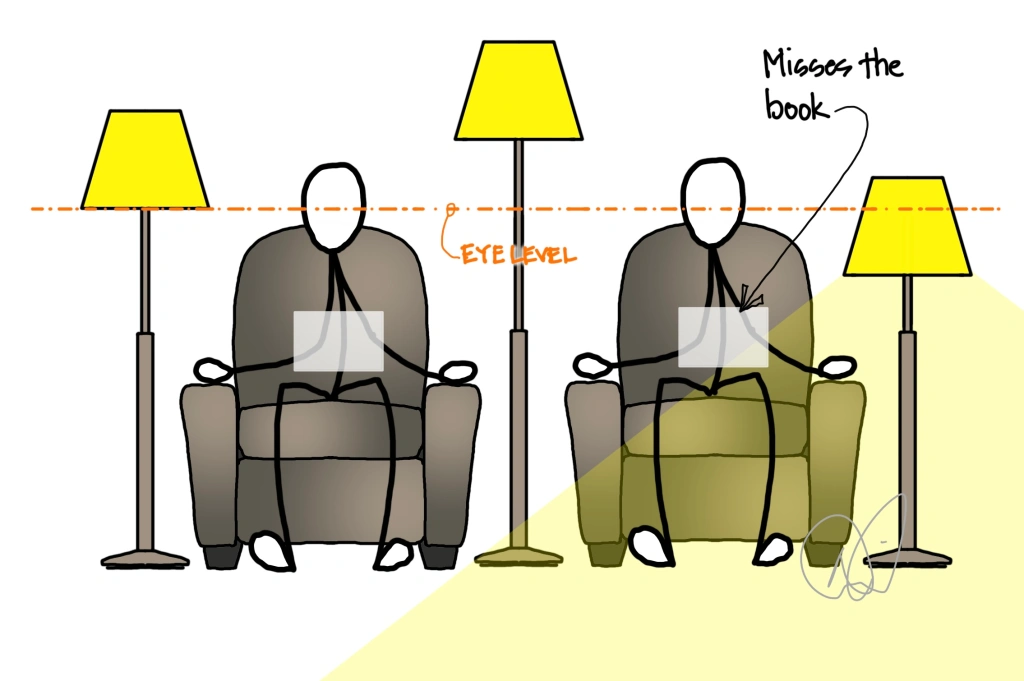
When a lamp has a short base or is on a low table, the shade may end up being too low. The easiest way to tell is to turn off all the other lights in the room and then look for the circle of light that comes out of the bottom of the lamp shade. If it touches the arm of the couch but does not spill out far enough to cover your lap, then the shade is either too low or the lamp needs to move closer to the couch.
Another risk of low lampshades is increased glare when you are standing near the lamp. This is usually not a significant issue if the lamp is up next to a wall, but if you regularly walk by the lamp, keep an eye out. Once again, if you can see the bulb from above or below, you have glare.
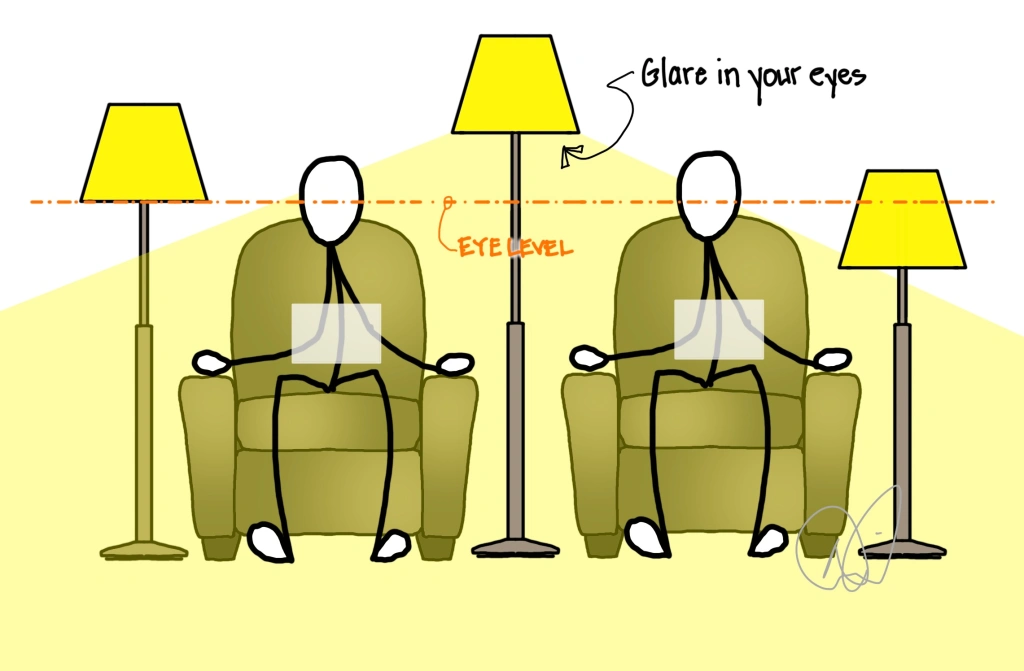
Conversely, lampshades too high might do a wonderful job lighting your book, knitting, or e-reader, but if you can see the lightbulb then you are introducing unnecessary glare and discomfort into your eyes.
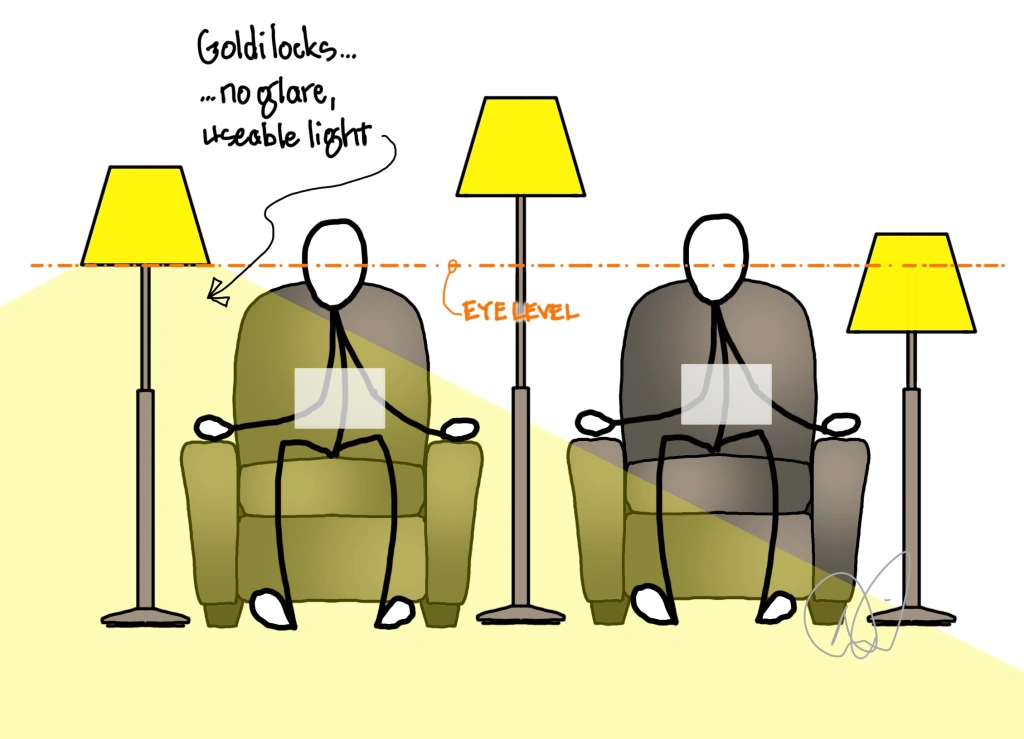
There is no magic number for lamp height, but there is a magic line – your eye level when seated near the lamp. Aligning the bottom of the lamp shade with your eye level will protect your eyes from glare while maximizing the spread of light into the Work Zone, making it easier to see what you hold in your hands. Your eye level is essentially determined by the length of your torso (body height) and the height of the seat.
I think every table and floor lamp should have vertical adjustability to raise and lower its height, but that feature turns out to be exceptionally rare. Neither fashion trends nor profitability benefit from adjustability at the moment – it costs more to build into a lamp and fashion cares more about looks than function. I look for lamps with adjustability personally – four of the lamps in my current living room adjust vertically or horizontally – but I have also used a simple stack of books to raise lamps to their ideal height.
Before I write the Pick the Products post for the living room, I want to take a deeper dive into reducing glare through careful examination of sightlines. So if you dig geometry lessons, stick around.