
One of the perennially difficult aspects of the role of lighting designer is the struggle over budget allocation. Lighting is most often viewed as a utility or commodity, something to be installed as cheaply as possible, but that too often robs the homeowners of comfort, relaxation, energy, and more. So how do we help homeowners understand that lighting should be a carefully considered investment in their daily health and wellness? How can we help them see the value of light? While there are many answers, the power of analogy is a favorite. If people do not understand lighting – and there is little reason they should – then let’s talk about something they do understand.
“All custom homes should feature 12×12 peel-and-stick vinyl floor tiles in every room.”
Stephanie, a member of our team who regularly talks to clients, architects, builders, and interior designers about the value of light, recently shared one of her favorite analogies with me, and I was, to make an obvious pun, floored by its simplicity and comprehensiveness.
So let’s talk flooring.
My first job after finishing my undergraduate degree in architectural studies was designing and building houses with Habitat for Humanity in the rural Mississippi delta. Each home was a significant step up from the dilapidated shacks left over from a bygone sharecropping era but were by no means luxurious. Our entire construction budget (which included only a bit of labor for foundations and plumbing) hovered around $30,000. Imagine building a home for $30K??
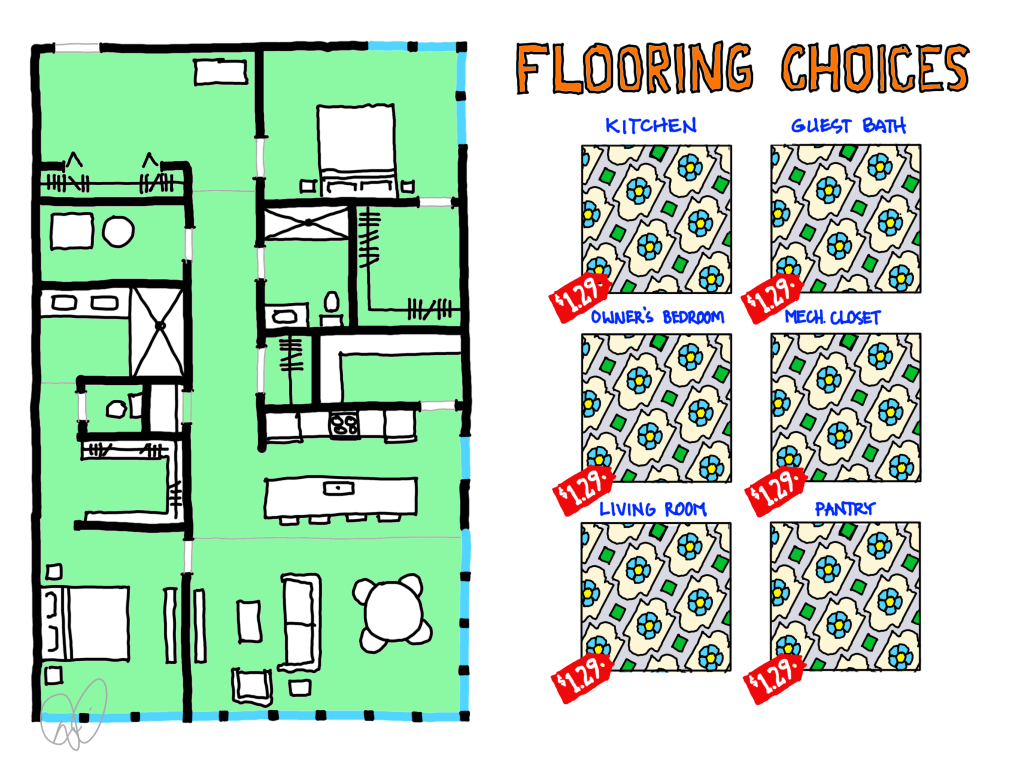
One of the many ways we lowered costs was to utilize the least expensive flooring option throughout the entire home. At the time, 12” square vinyl floor tiles, the kind you lay down over a thin bed of adhesive, where the chosen solution for our slab-on-grade homes. Every room from kitchen to bath to bedroom to living room had the same tiles that always reminded me of grade school flooring.
Now imagine building a custom home, or even luxury home, with 12” vinyl tiles on every floor. It just isn’t done. Why? Because cheap flooring will negatively affect every moment in the home, in one way or another. Beauty will be threatened. Floors will be uncomfortable. Dirt will show. Finish will wear. You will be left with flooring that works, at a base level, but cheapens the entire experience, day after day.
This is what we do with lighting. But it isn’t what we do with flooring.
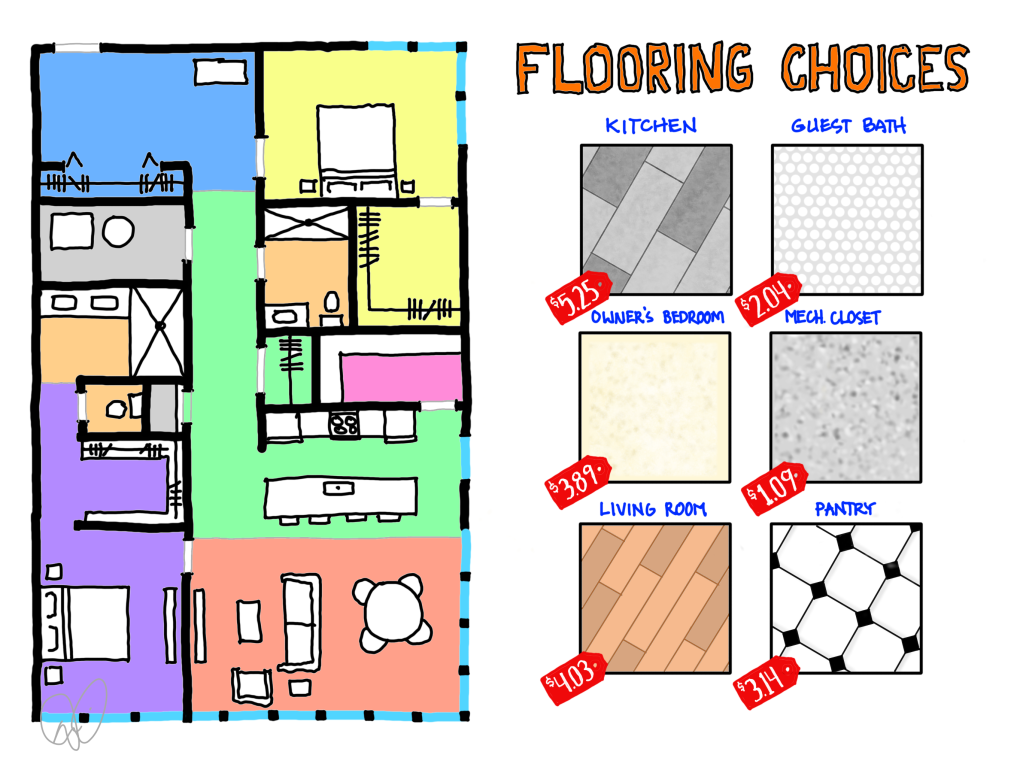
Stephanie points out that clients and their teams pore over countless flooring samples, carefully selecting the right material, finish, pattern, and color for each space of the home. Perhaps the kitchen has a 12” x 24” marble tile, while the guest bath has classic “penny” tiles. The owners requested thick carpeting in their bedroom with double padding, while the mechanical closet is finished with polished concrete. And so on.
There are budget implications of every choice. The marble in the kitchen will cost more than the carpet; the penny tiles will require more installation labor than the polished concrete. Budget dollars are carefully allocated room by room, with more dollars spent in the most important spaces. Occasionally the homeowner will fall in love with a particular flooring choice that requires digging deeper into the wallet, but they can see the beauty and want to enjoy it every time they take a bath.
Clients and their teams can see flooring, they can feel it in their hands, and they instinctively know material uses and cost differences.
Try holding light in your hands to feel the texture. You can’t. It takes, well, experienced professionals, imagination, and trust.
Without the ability to easily understand lighting, we default to the safe place of “watching the budget” by minimizing the spend.
And that means we regularly put cheap-o lighting in every room of the house.
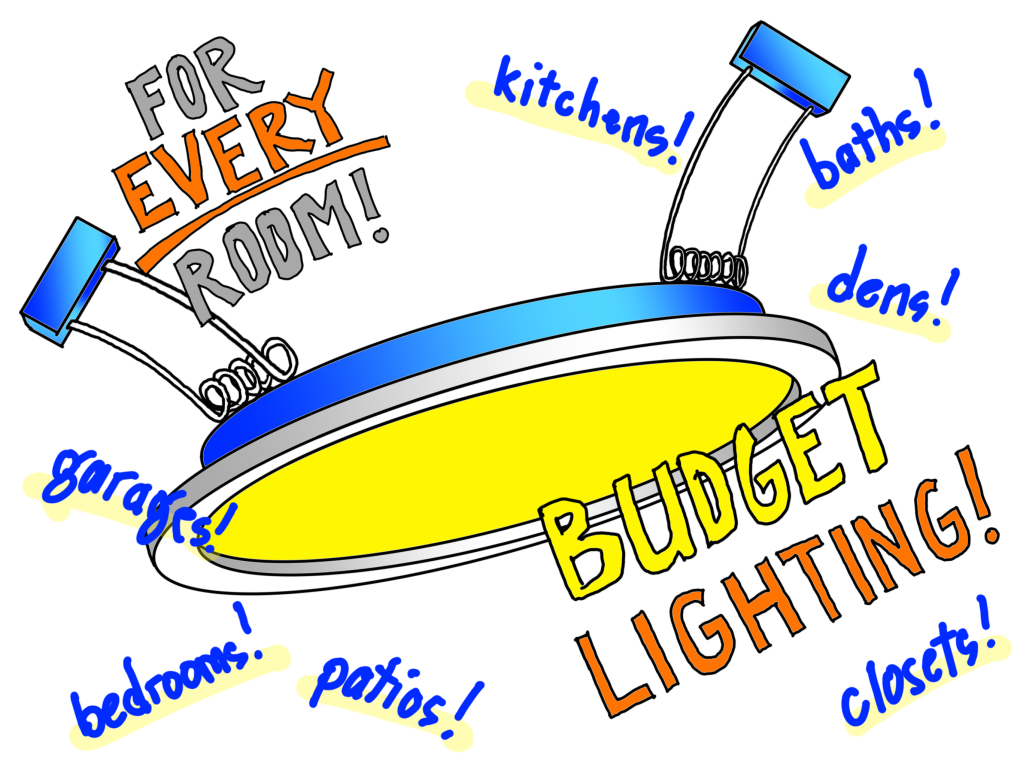
Just like the carpet example in the first sketch above, wafer lights, disc lights, and LED trims are hailed as a perfect solution for every room of the house. They can go everywhere! I regularly see multi-million-dollar homes with these $15 wafers throughout.
They might as well put peel-and-stick vinyl tiles on the living room floor.
What is the answer? If you are a homeowner, you can learn more about the potential of light and/or hire professionals. If you are an architect, interior designer, or builder, you can start by re-opening the lighting budget conversation and bringing in expert help.
If you are a lighting professional, maybe it’s time to talk about flooring.
Thanks, Stephanie. This is one solid analogy to stand on.