The Simple Gift of Light #7
The key benefits of light- gentle mornings, energetic days, relaxing evenings, and restful nights- come only when we consume the right light at the right time. But what makes some lighting good and other lighting bad? There are seemingly endless technical considerations that quickly get overwhelming and, honestly, few of us want to truly understand Correlated Color Temperature or Color Rendering Index or Lumens or any of the other important lighting terms.
The good news is that we can leave the deep science and complicated technologies to the experts but still live better lives at home. Of course, I believe that the science, technology, and biology of light is of critical importance and, as a society, we can benefit immeasurably by deeply investigating every avenue. I can geek out on this stuff all day long. But at night, when I come home after a long day of work, I don’t want to analyze and tinker. I want to relax.
If every human is not destined to study light and lighting in depth, does that mean most of us must therefore miss out on the benefits? Absolutely not. By following a few simple guidelines, we can grasp many of the promises of light without fully grasping the science behind them. One approach to reaching that goal is to use what I call the Four Zones of Light. The zone concept will help you get the right light in the right place, one of the bedrock principles of good lighting.
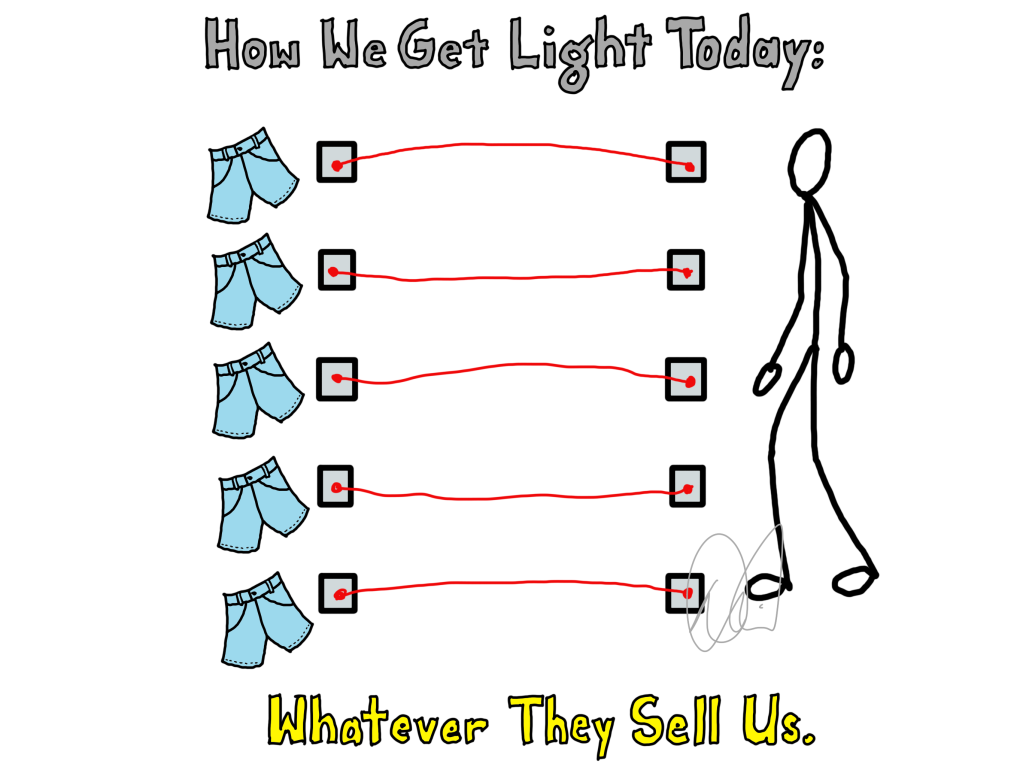
Imagine, for a moment, that we are talking about clothing instead of lighting. On a typical day we might wear a number of different items, each with its own purpose and function. But what if the clothing industry offered you only one choice: denim shorts? There might be nothing particularly wrong with denim shorts, but surely this would not fill every need. You would look (and feel) a little silly, perhaps even exposed, walking around down with denim shorts draped over your chest and on your feet and on your head. Dumb, right?
Chances are pretty good that your home is lit with the equivalent of denim shorts: the wafer or disc light, or perhaps overhead lights or ceiling fan lights. These light sources all have a place and time to be used, but we tend to place them everywhere and use them all the time.
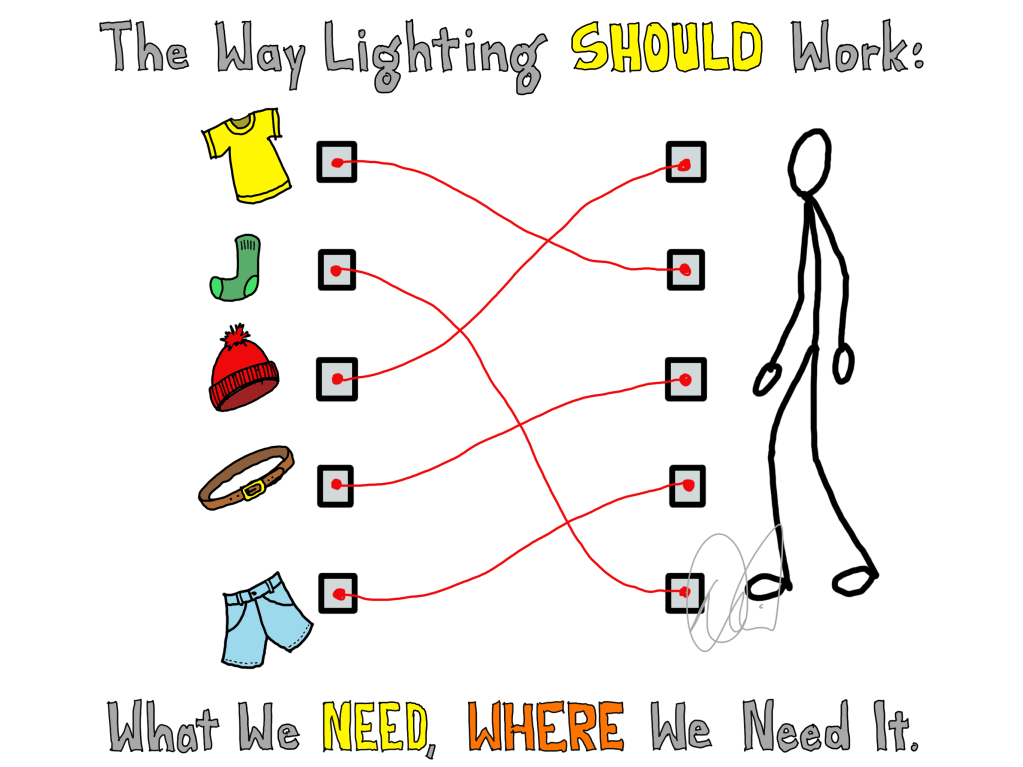
A more reasonable solution would be to choose socks for your feet, a shirt for your torso, a hat for your head, a belt for your waist, and, yes, those denim shorts for your legs. Now those denim shorts become useful and appropriate.
Most lighting also has an appropriate use, and Lighting Zones can help you find it.
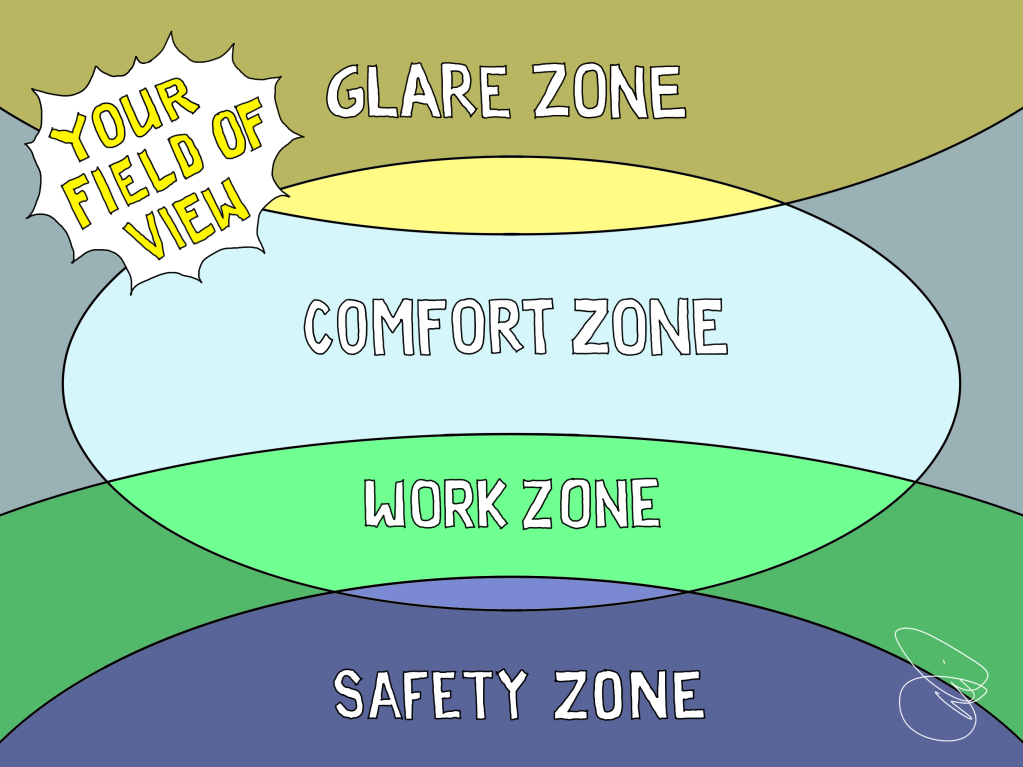
Let’s start with a simple exercise: look away from this page and straight out in front of you. What do you see? Look around the room, without bending your neck upwards or downwards. What you see, whether it be computers or paintings or windows or walls or cabinets, is what experts call your “field of view.”
Our field of view can be divided into different zones like our focused vision and our peripheral vision. You may be familiar with the latter term, most commonly used to describe the outermost reaches of our vision like the “corner of our eye.” Our peripheral vision is highly sensitive to light – that’s what makes it so easy for us to see movement in that zone – but that sensitivity comes at a cost. Try holding a book to the side of your head and you will most likely find it impossible to read.
Now move the book back in front of your eyes where you can read it. You are now using your foveal or focused vision, the sweet spot where we can see detail, read emotions on faces, and accomplish visual tasks. Perhaps you remember the “rod” and “cone” cells in our eyes, those light-sensing cells covering the retina at the back of our eyeballs. Our peripheral field of vision is dominated by the more sensitive rod cells; our focused field of vision contains tightly packed cone cells.
We can break our field of view into zones that help us understand what kind of light we need in each place. Our peripheral vision overhead can be called the Glare Zone so we are reminded of our elevated sensitivity to bright sources in that area.
Our sweet spot of vision, often using that focused field of view, can be called our Comfort Zone. When we tilt our head downwards to see a book or knitting or cutting board, our focused vision moves and we now have a Work Zone.
Finally, in our peripheral vision below, we have a safety zone of vision that keeps us from tripping over curbs and LEGO on the floor. Our eye is so well built for this task that we can often walk forward without staring at our feet, trusting our brain to pick out the hazards as we move.
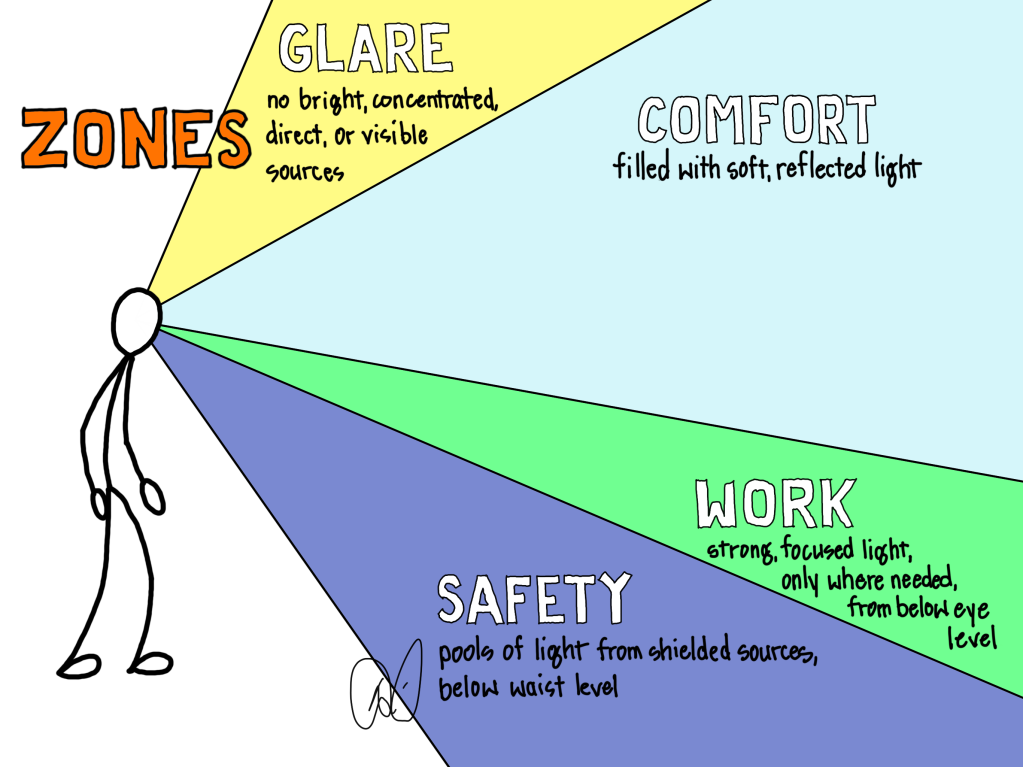
Here is a side view of our field vision with the four zones. Each zone, because it is made up of a unique mix of those rod and cone cells on our retina, needs a unique mixture of light. Knowing what is needed in each zone unlocks the benefits of light.
Our Glare Zone, for example, needs to be free of bright, concentrated, direct, or visible sources of light. That means no bright overhead lights, no spotlights, no bare light bulbs in clear-glass-shaded fixtures, no ceiling fan lights pointing at our faces.
Our Comfort Zone should be filled with soft, reflected or diffused light, like the natural sky on a summer day. If this zone is left dark, we will feel something is missing. Bare bulbs and other bright sources, like in the Glare Zone, will cause discomfort.
We need strong, focused light in the Work Zone that illuminates whatever we are doing, our task, without adding glare to our eyes. Ideally, light in this zone would come from below our eyes and be pointed away from us, like from a shaded task lamp or undercabinet lighting.
Finally, we need pools of soft, dim light in our Safety Zone, preferably from below our waistline and also from protected, hidden, or shielded light sources. Think of a traditional conical hat-style landscape path light and you will be on the right track.
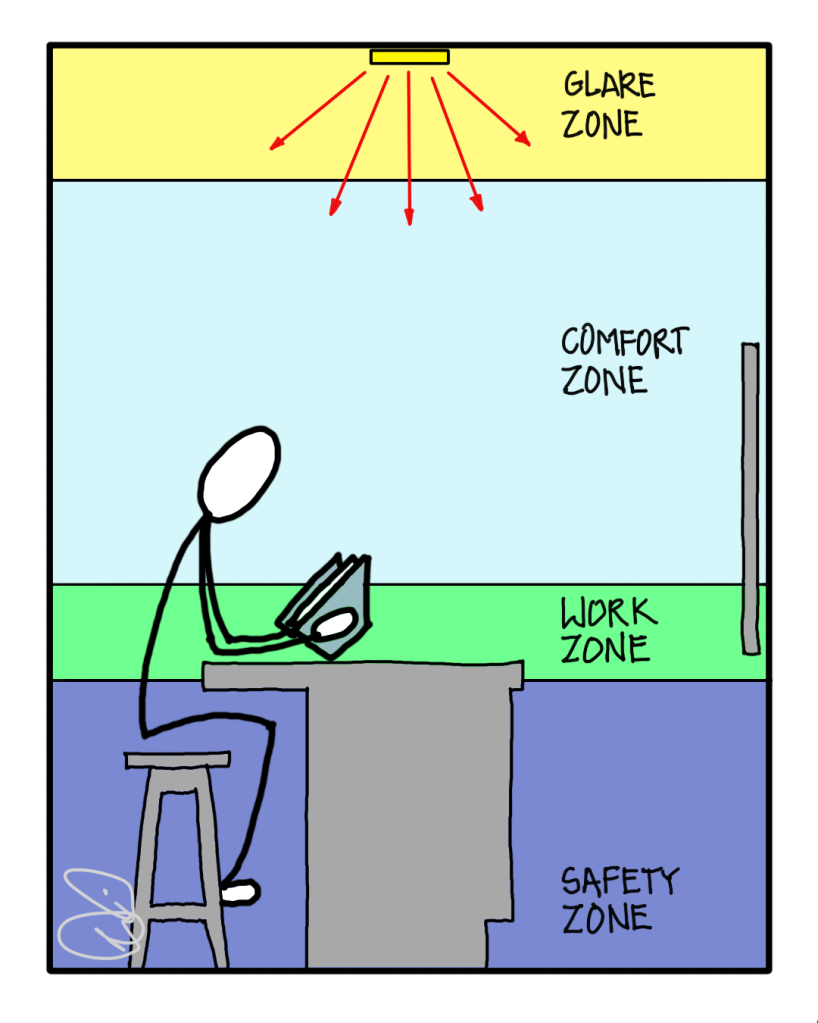
So what does “Zone Lighting” look like in practice? In the simplified graphic above, there is a bright overhead light in the Glare Zone, the only source of light in the room. This all-too-common approach concentrates the light in the exact location where it will do the most harm and the least good. The Comfort Zone will have some light, depending on the source, but is not filled with reflected light. The Work Zone and Safety Zone will have light, but not the best kind of light. And the Glare Zone will be full of its namesake, causing subconscious discomfort every minute.
We have trained ourselves to accept harsh overhead lighting, most likely from a young age. Our schools are filled with it, our workplaces rely on it, and most of our homes have nothing but what is shown here.
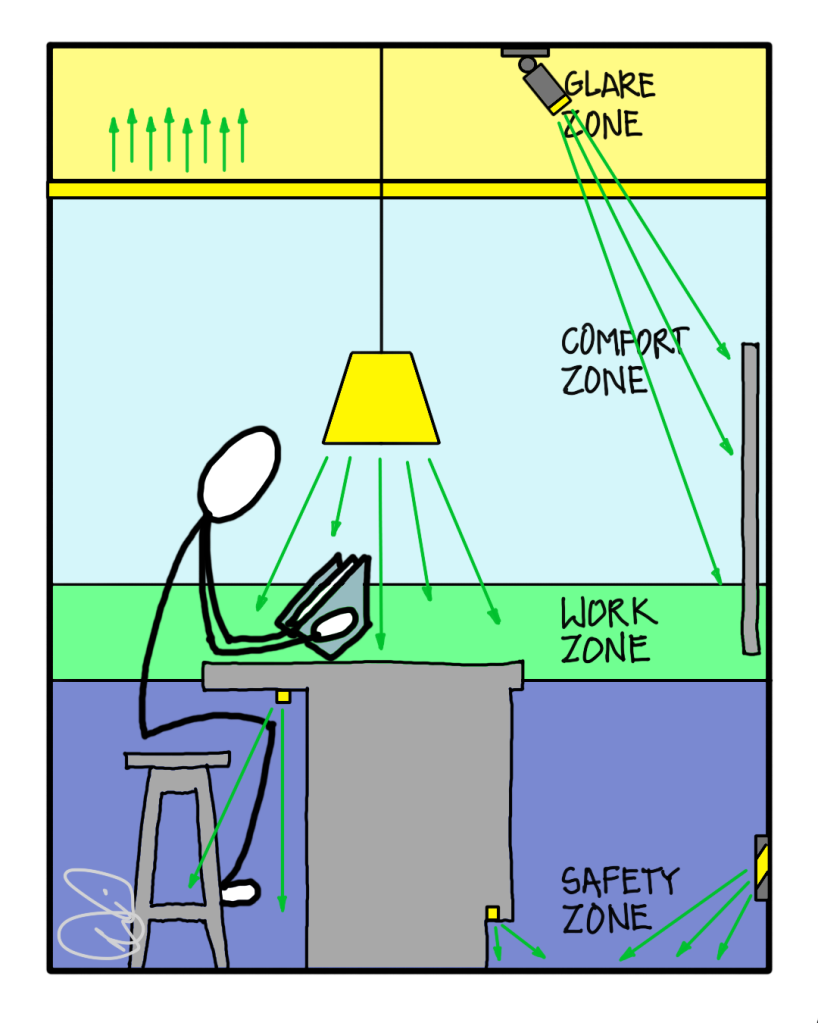
The alternate solution will look and feel completely different, potentially using absolutely none of the same lighting techniques and fixtures as bad lighting. Note the Glare Zone has soft reflected “indirect” light from a horizontal trim piece and the only spotlight is deliberately pointed away from our eyes as we sit and read.
The ceiling-mounted spotlight reflects off art, cabinets, or architectural features and is easy on the eyes while helping us feel more comfortable. In essence, this light delivers “brightness” without glare to the Comfort Zone, as does the fabric-shaded pendant above the island.
The Work Zone is lit, in this case, from a carefully selected decorative light fixture that directs most of its light downwards. Getting the light source closer to the book means we can use fewer lumens – essentially less light – while achieving the same brightness on the book.
The Safety Zone has three different sources, all coming from below the waist and pointing towards the floor. Light beneath the bar top, in the cabinet toe kick, and in a recessed path light (often called step lights) all provide the pools of light that help us feel safe and navigate darkness with ease.
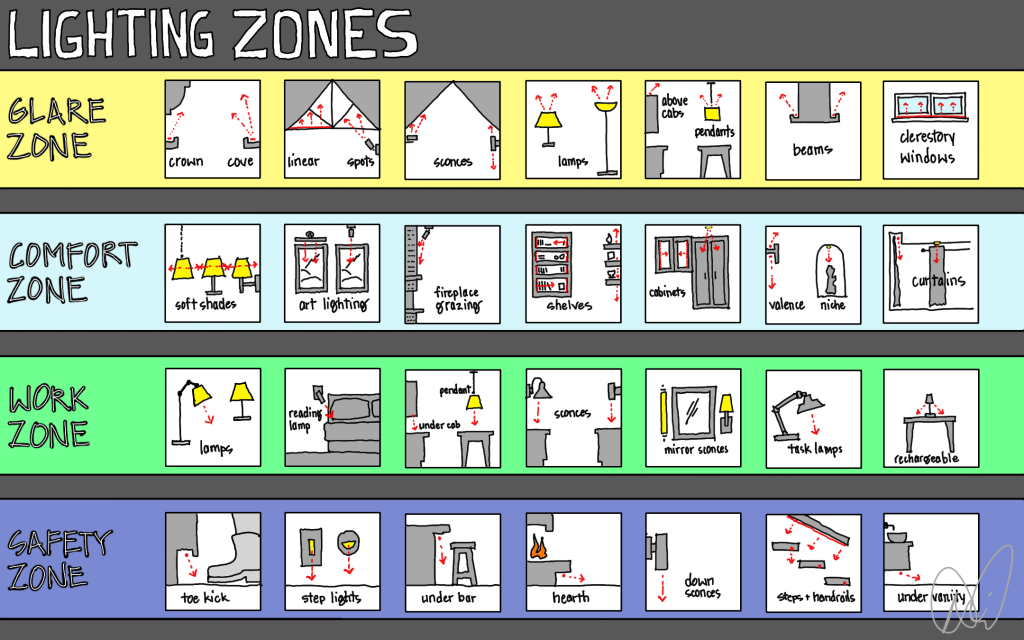
I’m going to write a little more about each Zone in the next few posts of the series, if I can find a way to keep it from getting too technical. There is plenty of technical, practical, specific advice on each Zone in the Giving the Simple Gift of Light series, broken down by room, but the goal is to make this series less technical, more of a manifesto than a blueprint.
So let me leave you with a cheat sheet of lighting solutions for each Lighting Zone. The illustration above is by no means exhaustive, but just a few favorites by zone to help you get creative. The concepts range from the ease of plugging in a table lamp to the complexity of integrating linear lighting directly into ceiling beams, but the ultimate results should be the same: gentle mornings, energetic days, relaxing evenings, and restful nights.
All that can be ours when we get in the zone.